Saturday, June 29, 2024

Spader Fetish

James Spader is such an interesting actor. By no means have I done a deep dive into his filmography, but it's generally known that he is attracted to dark and/or sexual roles. And, you know, Boston Legal. He's a weird guy and that's why we love him. I recently had the opportunity to watch a sexy Spader movie I hadn't seen before (Sex, Lies, and Videotape), and a..."sexy" (????) Spader movie I have seen before and wiped from my memory (David Cronenberg's Crash), so I thought I would review the two films and round them out with one of my all-time faves, which is also a sexy Spader movie, Secretary.

***

Sex, Lies, and Videotape

Directed by Steven Soderbergh, Sex, Lies, and Videotape is a film that dips its toe in the waters of sexual liberation but ultimately pulls back and reinforces the value of "normalcy".

The film follows four people: married couple Ann Mullany (Andie MacDowell) and John Mullany (Peter Gallagher...oddly enough looking a lot like comedian John Mulaney and basically sharing the same name), Ann's sister Cynthia (Laura San Giacomo), and John's old friend from college, Graham (Spader).

Ann confesses to her therapist that she doesn't really like sex and thinks that masturbation is "a dumb thing to do". In 2024, we'd probably call her asexual, demisexual, or gray ace. But in 1989, when the movie was made, she just comes off as a prudish wife. John is sleeping with Ann's sister, Cynthia, who is just a terrible person. John is also a terrible person (total finance bro type). His college friend Graham comes back into town and when John finds out that Graham is weirder and quieter than he used to be, John basically writes him off. However, Ann takes a liking to Graham. She inadvertently finds out Graham's unusual hobby: he films women talking about sex. He interviews them and lets them talk for as long as they like about anything they want related to their sex lives. Sometimes they do more than talk, only not with Graham, who is impotent.

Ann is is freaked out and disgusted by Graham's voyeuristic proclivities. But she eventually comes back around to liking him when she discovers her sister and husband's betrayal. She even asks to be interviewed, and ends up turning the camera on Graham.

Sex, Lies, and Videotape is very character-driven movie and even though I didn't particularly like any of the characters, I found myself drawn in. The acting is very strong, especially MacDowell, who, despite her judgmental attitudes about sex, is a compelling and sympathetic protagonist. 

The film approaches voyeurism with ambivalence. On the one hand, Graham's hobby, which really is the way he experiences his own sexuality, is treated as a deviancy and a personal defect. At the same time, the scene where Graham interviews Cynthia is easily the sexiest scene in the movie. In fact, the very idea of a man asking *me* questions about my sexuality and then listening is mind-blowingly hot. But also, I'm a big talker. 

As I say above, Soderbergh plays with the idea that sexual "deviancy" can actually be normal and even healthy for some people while stopping short of celebrating and affirming unique expressions of (consensual, adult) sexuality. But for the time period, I can see why this movie was considered cutting edge. 

Grade: B+

***

Crash (1996)

Not to be confused with Paul Haggis' extremely stupid 2004 movie, David Cronenberg's 1996 film Crash, based on the novel by J.G. Ballard, is truly transgressive. In short, the film is about car crash fetishists. People who get sexually aroused by being in and by watching car crashes. 

Crash is one of the most sexually explicit non-pornographic films I've ever seen (undoubtedly, it is considered porn by some, but not by me). This100 minute movie contains 8 or 9 full-on sex scenes. There are scenes with women and men, two men, and two women. Can I say it any more clearly? This movie has a lot, and I mean A LOT of fucking in it. Yet...my god, is this movie not erotic at all. 

Well, maybe it's erotic if you're into car accidents. Or wounds created by car accidents. But it's not just the whole car crash fetish aspect that makes the film un-erotic, it's the robotic affect of many of the film's characters. The main couple, James (Spader) and his wife Catherine (Deborah Kara Unger), have an open marriage where they frequently have sex with other people and then share their experiences with one another...but they seem to achieve no satisfaction or joy from these encounters. They seem frigid. Even dead inside.

After James gets into a near-fatal car accident, he gets pulled into the world of car crash re-enactors and fetishists, led by Robert Vaughn (Elias Koteas, the best thing about this movie). Vaughn and his crew re-enact famous car crashes, such as the one that killed James Dean. Vaughn brings danger and passion into James and Catherine's lives, but also the very real possibility of dismemberment and death. I LOVED Elias Koteas in this role. In a movie positively dripping with sex, Vaughn is one of maybe two characters (the other being Rosanna Arquette as Gabrielle, another car crash fanatic) who actually seems horny. Vaughn is also a violent, unstable nutcase, but I guess you take the good with the bad.

So, what does this film mean?? Well, it's a Cronenberg film and much of his oeuvre deals with the intersections of man and machine and how technology affects humanity. Or maybe it's about America's love affair with cars? I don't know man, but I have to give Crash a rating in the "A" range because even though it's a deeply unpleasant and off-putting movie, it is really, really transgressive and just swings for the fences in a way so few movies have the balls to do. There is something really admirable about that. 

Grade: A-

***

Secretary

You gotta be living under a rock if you haven't heard about Secretary. Directed by Steven Shainberg, Secretary is about a meek woman, Lee (Maggie Gyllenhaal) who is released from a stay at a mental hospital for self-harm. Seeking work, she finds an ad for a secretarial position to lawyer E. Edward Grey (Spader). Mr. Grey is an odd, exacting boss who chastises Lee for small mistakes. But Lee rises to the occasion and becomes a very, very good secretary. 

The two weirdos fall into a Dominant/submissive relationship that they keep at work. It involves Lee being spanked for typos, crawling on the floor to deliver letters to Mr. Grey, and being put in bondage. Lee absolutely flourishes as a woman and as a human being in these conditions. Her sexuality is awakened. Her need to self-harm evaporates (more on this below). She is happy, beautiful, and glowing under the care and discipline of Mr. Grey. 

Lee realizes that she wants more from Mr. Grey. She wants them to do their thing 24/7 and, you know, be together as a couple. Grey pulls away. It turns out that he is very ashamed of his desires. There's a scene where Lee listens to an audiobook titled "Coming Out as Dominant/submissive" while at the same time Grey is writing her letter that starts with "I'm sorry. I don't know why I'm like this." I love this scene because it demonstrates that the roles people play in BDSM don't really say much about who they are as people outside those roles. In other words, sexually submissive Lee has the confidence and curiosity to learn about and embrace her desires while dominant Mr. Grey is beating up on himself (pun fully intended) and is too scared to be his authentic sexual self. So it is up to Lee to prove her worthiness to Mr. Grey and also to prove that they are worthy and deserving of the kind of love that feels right to them.

Secretary is a feminist film with a strong, smart, courageous heroine who isn't perfect and has a lot of growing to do, but learns to stand up for herself and for her man. All while getting spanked over a desk. Secretary is also one of the few movies about BDSM that seems to actually "get" that BDSM is a lot more complex than whips, chains, and leather. To be clear, people live and express BDSM in a million different ways, not just in the way that Lee and Grey do, but Secretary gets that this way of expressing love, power, and sexuality is generally pretty integral to people who are wired for it and that you can't just "be normal" if you're built different. And also that BDSM is not something to be ashamed of. Unlike Sex, Lies, and Videotape, Secretary *affirms* so-called "deviant" sexuality, it doesn't just gawk at it.

That said, the film still has its flaws, the biggest of which is that Lee stops self-harming because Grey tells her she doesn't need to anymore. That's not the way that works. BDSM is not therapy, though it can be therapeutic. And mental illness doesn't go away because a Dom tells you that you're better. However, I'm inclined to let that issue slide because Secretary presents a fantasy. After all, Grey positions Lee over a desk one day and spanks her...and she likes it. In real life: don't do this. It's a romance. Much like Bridgerton, it ain't real life. In addition to being a fantasy, Secretary is also a comedy and the humor is pretty dark and wry at times. This is a special movie and not everyone is going to be on its wavelength. But those who get it and like it really like it, and I'm one of them. 
 
Grade: A+

Saturday, June 15, 2024

Furiosa

Mad Max: Fury Road was one of the best surprises I've experienced at the movies. Having never watched the original trilogy (given my disdain for Mel Gibson, I probably never will) and also not really being into action movies, I had no plans to see Fury Road. But then the reviews started rolling in saying that it was an eye-popping spectacle and one of the best movies of the year. I saw it with some friends and was blown away by the film. Visually, it's stunning. The action sequences are entertaining and wild. The world-building, right down to the slang the characters use ("I shall ride eternal shiny and chrome!"), is fascinating. Overall, I had an intensely positive experience seeing Mad Max: Fury Road and it was one of my favorite movies of 2015.

When discussing the sequel/prequel, Furiosa: A Mad Max Saga, which tells us the origin story of Imperator Furiosa, played by Charlize Theron in Fury Road, people want to compare the two movies and, from what I've read and heard, Furiosa seems to always come up short. In other words, people *like* Furiosa, but they *love* Fury Road. 

I understand that...and I don't. To me, Furiosa is just more of a wonderful thing.

Furiosa is longer than Fury Road by a full 30 minutes and while there are some parts that could have been slimmed down, that extra time is mostly spent developing the characters and fleshing out Furiosa's story. The movie is divided into 5 chapters and the first focuses on Furiosa's childhood in the matriarchal Green Place: an oasis of vegetation in the Wasteland. When raiders discover the Green Place, they kidnap Furiosa (who is around 8 or 9 when this happens, played by excellent child actor Alyla Browne) and bring her to Dementus (Chris Hemsworth, the true MVP of the film), the cult-like leader of the Biker Horde.

After a failed attempt to overthrow the Citadel, Dementus ends up trading Furiosa to Immortan Joe, who sees her as a potential future wife. But young Furiosa cuts her hair short and pretends to be a boy, working on war rigs with other men. She finds a mentor in Praetorian Jack (Tom Burke), who teaches her how to drive war rigs. At this point in the movie, Furiosa is played by Anya Taylor-Joy. Taylor-Joy is very good in this role, though I admit I wasn't completely blown away by her. As mentioned above, the actor who impressed me the most was Hemsworth as the charismatic Dementus. 

Throughout her years of work and training at the Citadel, Furiosa never forgets Dementus and never forgives him for kidnapping her from the Green Place and murdering her mother. By the end of the film, she has a chance to confront Dementus about these crimes. The exact way she gets her revenge is *chef's kiss*. I won't spoil what happens, but gasped when it was revealed. 

Furiosa is a highly enjoyable movie. I think when Fury Road came out, there was an element of surprise. I know that I had never seen a movie quite like it and it left a huge impression on me. With Furiosa, I knew what I was getting. I think this may be one reason why the general consensus is that Furiosa is not quite as good or impressive as Fury Road: simply, the element of surprise is gone. However, in some ways I think Furiosa is the superior film. The characters are more fleshed out and three-dimensional. The main villain is more interesting and complex. The movie is more emotional. 

All this is to say, I love both movies and if you liked Fury Road there's a good chance you'll enjoy Furiosa as well. 

Grade: A-

Saturday, June 1, 2024

Stuff I watched in...May, 2024

The Birdcage

Somehow I made it to ripe old age of 38 without seeing this genius film in its entirety. Sure, I saw the "Fosse Fosse Fosse!" scene and the "men smear" scene...but for whatever reason I hadn't sat my ass down and just watched the entire movie. And boy am I glad I finally did. Directed by Mike Nichols and starring the late, great Robin Williams as well as Nathan Lane, Hank Azaria, Gene Hackman, Dianne Wiest, and Calista Flockhart, The Birdcage is unbelievably funny. I haven't laughed this loud at a movie in a long time. 

The movie is a bunch of gay jokes, including numerous uses of the f-slur, but the gays are in on the joke. Which means that I feel comfortable laughing when Hank Azaria's flamboyant Agador bristles at the idea of wearing a butler's uniform, saying, "No! I'm gonna look like a fag!" (I had to pause the movie because I was laughing so hard at that line). I can't even comprehend how hilarious this movie is. Everyone is bringing their A-game. 

In case you also live under a rock, The Birdcage (based on the 1973 play La Cage aux Folles) is about a gay couple (Williams and Lane) whose son is getting engaged to a woman with conservative parents. So when the parents come to visit, they have to play straight. Or rather, Williams plays straight and Lane dresses in drag, pretending to be the wife. Much hilarity ensues. 

At the center of the movie is a message about accepting the people you love just as they are and how life is more vibrant and joyful when people are allowed to be themselves. It's interesting to me that for a film that features quite a few objectively awful people (Hackman's conservative Senator Keeley, Christine Baranski playing Val's absent mother, and Dan Futterman playing Val, the son who is getting married and selfishly pushes for his dad(s) to pretend to be straight) the movie doesn't dwell on any negative emotions. The result is a pro-social film that encourages acceptance without feeling preachy or "politically correct". Given all the horror and intense dramas I tend to be attracted to, a movie as funny, colorful, and joyful as The Birdcage is a breath of fresh air.

Grade: A+

***

Everybody Wants Some!!

If you love the movie Dazed and Confused and wish there was a sequel, Everybody Wants Some!! is about as close as you're going to get. This 2016 film is directed by Richard Linklater (who also directed Dazed and Confused) and follows the members of a college baseball team during the weekend before classes begin in August of 1980. Freshmen pitcher Jake Bradford (Blake Jenner) shows up at one of the designated off-campus "baseball houses" where the team will live together and is immediately thrown into the frat boy-esque chaos of a bunch of horny, beer-swilling, competitive guys living together. 

Over the course of the weekend, the fellas bond over parties, beer, "college pussy", games (ranging from pinball to ping-pong), massive bong rips, and, of course, baseball. A few of the older guys give Bradford and the fellow freshmen shit, but a couple others take them under their wings and give them advice about how to "piss with the big-dick dogs". It's honestly a really sweet movie, despite absolutely dripping with testosterone. Just as with Dazed and Confused, Linklater captures the poetic philosophy hiding underneath the hormonal hijinks of a bunch of young people. Few directors understand the contradictions of youth so well. Young people are immature, impulsive, petty, and shallow--sure. But they're also brutally honest, insightful, and can be very friendly when they want to be. Linklater captures all of it and delivers a really fun and often deeper than expected film.

Also starring Glen Powell as charming ladies man Finn, Tyler Hoechlin as the alpha male star hitter McReynolds, and Zoey Deutch as theatre nerd and potential love interest Beverly, Everybody Wants Some!! is a delightful comedy that is both horny and heartfelt. 

Grade: A-

***

Anyone But You

So after seeing Glen Powell in Everybody Wants Some!!, I became intrigued by (i.e. crushing on) the up-and-coming movie star. He recently starred opposite Sydney Sweeney in this romantic comedy, based loosely on the Shakespeare comedy Much Ado About Nothing. Even though I famously hate romantic comedies, I figured I'd give it a watch.

It was...ok. Powell is really good in it because he radiates a mixture of charm, smarm, and overall good-guy decency. I can see why he is climbing the ranks of Hollywood right now. He's a classic Hollywood leading man. Sweeney isn't bad--she holds her own against Powell and the two have really excellent chemistry. The initial meet-cute between Ben and Bea and their first conflict is actually pretty believable: she runs into a coffee shop asking to use the bathroom and they refuse to give her the bathroom key until she buys something...but the checkout line is 20 people deep. Ben sees her distress and asks for a peppermint tea for "my wife" indicating Bea, allowing her to grab the key and run to the bathroom. 

Bea and Ben have immediate chemistry and spend the day hanging out together and fall asleep together while talking. But Bea makes the strange decision to leave before Ben wakes up. Upon waking, Ben is distressed and feels used. When his friend Pete shows up, he tells him he couldn't wait to get Bea to leave--that she's "a disaster" and "she's nothing"....little does he know that Bea realized the mistake she made, returned to say goodbye, and overheard everything. 

Months later, the two meet again when Bea's sister Halle begins dating friend Pete's sister Claudia. And then a year or so after that, Bea and Ben find themselves on a plane to Australia to participate in Claudia and Halle's wedding. After their pushy parents and friends keep trying to interfere, Bea and Ben begrudgingly decide to pretend to be a couple to shut everyone up and keep the brides-to-be happy and calm.

Anyone But You is contrived, ridiculous, not funny (or only funny in a "sensible chuckle" sort of way), and everyone's problems could be solved with a single, honest conversation...in other words, it's a typical romantic comedy! The film is held aloft on the strength of the chemistry of its leads. The rest of the cast is mediocre at best and the worst thing about the movie is its goddamn RELENTLESS soundtrack. Basically every scene in the movie is paired with a not-good pop song, which is distracting and irritating. 

Fans of romcoms will likely enjoy Anyone But You. Hell, I didn't hate it. If it had better music and funnier jokes, I probably would have really liked it. 

Grade: B-

***

The Feeling That the Time for Doing Something Has Passed

For a movie with such a long title, Joanna Arnow's The Feeling That the Time for Doing Something Has Passed is a wisp of a film. The movie is so low-key that it barely even exists. And, strangely enough, I saw it by myself in a completely empty movie theatre (though I've gotten close, I've never managed to be the only person in a movie theatre for the entirety of a movie until this one). It felt oddly appropriate.

The movie follows Ann (played by Arnow), an unremarkable thirty-something woman who lives a very mundane life. She works a corporate job, has dinner with her aging parents, and has a very low-commitment, low-energy Dom/sub relationship with an older guy named Allen. She also dates a few other guys and eventually meets Chris, with whom she has a genuine connection. 

Each individual scene in this movie is about the length of a Mitch Hedberg joke. I don't think a single scene lasted more than 3 minutes and most were about 30 seconds long. It's like a series of one-liners. The movie is, frankly, very boring. There is no plot, little to no character development, no climax to the film. There are a few scenes that are more satisfying that others: for example, a scene where Ann's dad sings a pro-union song while her mom bangs on a pot and Ann leaves the room in annoyance. I liked that scene because it was genuinely funny and goofy. There's also a scene where Ann coaches Chris on how to dominate her and treat her like a sex object (which is what she likes). That scene had a real sweetness to it. But these moments are few and far between. 

Sex and BDSM play a significant role in the film and I appreciated the depiction of "deviant" sexuality as boring and silly. Not because I believe BDSM actually is boring and silly, but because it demystifies the whole thing and shows people who like a little power exchange in their romantic lives and sex lives to be the same old regular people as anyone else. There's a power in taking something taboo and making it mundane. 

I didn't hate this movie, but I can't recommend it. People who are into low-key "hangout" type films might dig it, but the majority of viewers will find it to be a snoozefest.

Grade: C+ 

***

The Coffee Table

This Spanish film, which came out a couple years ago, is making its rounds on TikTok as the disturbing movie du jour, so of course I had to check it out. All I knew was that it was about a couple that buys a coffee table and it ruins their lives. And if you want to check it out, you should probably go in knowing as little as possible--that's if you enjoy upsetting movies that make you feel upsetting things. If you don't like upsetting movies, then The Coffee Table certainly isn't the one to start with. And if you suspect you might be triggered by this one...eh, just stay away. That's my fair warning. 

**slight spoilers ahead**

The thing is, the couple that buys the table have a newborn baby. The salesperson keeps emphasizing the "unbreakable glass" of the table. I mean you pretty much know EXACTLY what's going to happen before it happens. I will say that the scene in which the obvious thing happens is deeply, deeply tense in a palpable way. I was holding my breath waiting for the thing I knew was going to happen to happen. Then it did. And the rest of the movie is the fallout from that event. 

The Coffee Table doesn't pull any punches. It's a mean movie with a fucked up sense of humor. I didn't love it, but it definitely made me feel things and left an impression. Probably one I'm never going to watch again. 

Grade: B

***

Bull Durham

After seeing Challengers, I was in the mood for another sexually-charged sports movie with a love triangle. Well, Bull Durham is good but it's no Challengers. Annie Savoy (Susan Sarandon) is a "baseball groupie" who picks one player on the Durham Bulls per year to sleep with and also mentor (by coaching them on how to improve their skills, since she actually does know a lot about baseball, but also by reading them the poetry of Walt Whitman). This year, she has two prospects: rookie pitcher "Nuke" Laloosh (Tim Robbins), who has a powerful arm but no discipline and veteran player "Crash" Davis (Kevin Costner), who is called in by the Bulls' coach to help whip Laloosh into shape. 

Even though Annie picks Laloosh (and has a commitment to remain faithful for the duration of the season), she and Davis grow closer together. Similarly, Laloosh begins to trust Davis and allows Davis to actually coach him and teach him "not to think" so that he pitches with more intuition and less anxiety. 

My issue with Bull Durham is that there is too much baseball. And I don't like baseball. I have a personal boundary around attending baseball games (which means: I don't). Sports in general don't interest me, but baseball is particularly boring. No shade to baseball fans! It's just not for me. The thing about Challengers is that even though it's about tennis, it's not really about tennis...it's about relationships. And I guess Bull Durham is also about relationships, but actual discussion of baseball as a sport takes up WAY too much time in the movie. So, sadly, this classic comedy just wasn't my bag. I'm glad I gave it a watch though!

Grade: B-

***

A League of Their Own

Well, now, hold on just a darn minute. Here's a baseball movie I actually like! And it even has actual baseball in it! But we all know that A League of Their Own is about WAY more than sports. It's about feminism, sisterhood, teamwork, and Tom Hanks playing the crass Jimmy "no crying in baseball" Dugan. 

This was not my first time watching A League of Their Own, but it had been a while and I'm so glad I returned to it. It's such a fulfilling movie. It's got such a good heart. The year is 1943 and since all the young, athletic men are at war, Chicago Cubs owner Walter Harvey wants to put a league of girl baseball players together. Sisters Dottie Hinson (Geena Davis) and Kit Keller (Lori Petty) are recruited...but it's more like Dottie is recruited for both her hitting skills and extremely beautiful looks and she'll only participate if kid sister Kit (a skilled pitcher in her own right) is also recruited. Thus we see the dynamic that has been thrust upon the sisters: Dottie is the beautiful, tall, talented sister and Kit is shorter, less polished runt who lives in Dottie's shadow, much to her chagrin. 

The sisters find themselves on the Rockford Peaches team along with tomboy Doris Murphy (Rosie O'Donnell), sexpot Mae (Madonna), and a host of other interesting and talented women. Their manager is the once very impressive, now very drunk Jimmy Dugan (Tom Hanks), who is more interested in scratching his balls than coaching. So Dottie basically has to lead the team, creating lineups and giving signals to the players. 

I'm not going to go into the entire plot because you've probably already seen it. In order to be taken seriously, the Peaches have to *both* be excellent players *and* exploit their looks and femininity. What I really love about A League of Their Own is that there the characters represent a range of ways to be a woman and although there are some unfortunate "she ugly" jokes aimed at poor Marla Hooch (Megan Cavanagh), the gals themselves don't put down or judge one another for the ways they choose to present themselves. And Marla Hooch falls in love and gets married, so ha! 

A League of Their Own is a wonderful film about what can be accomplished when women lift up, support, and encourage other women. Definitely one to show your daughters--and your sons!

Grade: A-

***

The Green Mile

I was 11 years old when Stephen King's The Green Mile was released in six installments. My mom purchased each of the six slim paperbacks and would leave them on her bedside table. I would sneak into her room and read them. I recall quite vividly feeling ill after reading about "The Bad Death of Eduard Delacroix" (iykyk). I don't remember if I read the entire book when I was 11. Probably not. I probably got a copy when I was a bit older, maybe 12 or 13, and read the entire thing. And it left quite an impression on me because I recently listened to the book on audio while traveling and could recall specific jokes or turns of phrase that had cracked me up as an impressionable tween. 

King's The Green Mile is an A+ book. Although it is a classic example of the offensive "magical negro" trope, where a Black person exists mostly to teach white people a lesson, I can't deny the power of this book. It's funny, it's sad, it's horrific at times and tender at other time. I would highly recommend reading it!

The movie, on the other hand, is Oscar bait. Directed by Frank Darabont and starring Tom Hanks, David Morse, and the late Michael Clarke Duncan, The Green Mile is often groan-worthy. King's book has a certain dark sense of humor that balances out the heartstring-tugging aspects of the story. The movie is overly sincere and, frankly, not dark enough or raw enough. Like I said, it's Oscar bait...specifically, 1990s Oscar bait, which means that it's a serious film that you can take your grandma to. 

Is it a horrible movie? No. It's fine. There are a few very emotional scenes, in particular the death of John Coffey, the large Black man with magical healing hands. Michael Clarke Duncan takes a character that could easily be a one-dimensional stereotype and infuses him with humanity and grace. Tom Hanks is Tom Hanks. It's not his best role. He's here to contribute to the Oscar campaign for the film. The real MVP of the movie, in my opinion, is Michael Jeter playing the aforementioned Eduard Delacroix, a prisoner on the Green Mile who is relentlessly bullied by one of the guards. Now there's a guy who can tug at your heartstrings, even while playing a rapist and murderer! 

tl;dr: you do not need to see this movie. The book is much better. But if grandma wants to watch it, you can feel pretty assured that she won't be too offended by it. 

Grade: B-

***

Thursday, May 2, 2024

Stuff I watched in...April, 2024

Baby Reindeer (TV series)

Baby Reindeer was a wonderful and intense surprise. The premise is simple enough: a bartender makes a kind gesture to a lonely woman, opening the door to years of stalking that escalates into physical attacks. But there is so much more to the 7 episode limited series than just that.

For one thing, the creator of the show and its star, Scottish comedian Richard Gadd, actually lived through this. The series is based on his one-man show of the same name which recounted his years being stalked by "Martha" (not her real name) and all the confounding choices Gadd himself made during this time. I say "confounding" because at various points in the storyline, Gadd--playing a version of himself named Donny Dunn--fails to see red flags, set boundaries, explain what is going on to others, and take decisive action prompting the viewer to yell "WHAT!?" at the screen multiple times.

But, ah, there is good reason for Donny's passivity. And I implore anyone interested in seeing the show with a blank slate to stop reading here and just go watch it (it's only about 4 hours in total). Please do look up appropriate trigger warnings because, hoo boy, is there a lot of upsetting material in Baby Reindeer, but this show is 100% worth the watch.

SPOILERS BELOW!

It is revealed partway through the series that years before Donny encountered Martha, he was a struggling comedian who had a run-in with Darrien, a powerful writer with successful TV series under his belt. Under the guise of "mentorship" and "working together", Darrien encourages Donny to do harder and harder drugs with him. While Donny is out of it, Darrien molests him. Donny always feels ashamed after these encounters but keeps going back every time Darrien calls him. It builds up to a horrific encounter where Darrien rapes Donny after having him take a mixture of GHB and LSD. 

Although Donny is able to break away from Darrien, he cannot escape the emotional toll of his experience. He becomes sexually confused, not sure if he prefers men, women, or both. He has meaningless encounters with people of every gender just to feel wanted. He feels intense shame and his self-esteem is in the trash. In other words, he is the ideal person to fall victim to a woman who shows up in his life and becomes obsessed with him. Both because it feels good to Donny to feel wanted, but also because it makes it that much harder to report Martha to the police: Donny reasons that what Martha is doing is not as bad as what Darrien did, and he didn't report Darrien, so what "right" does he have to report Martha?

Baby Reindeer is an astoundingly vulnerable and honest look into the mind and decisions of people who have suffered from abuse. Richard Gadd strikes a beautiful balance at revealing his own missteps while never blaming the victim (in this case, himself). He is also careful to show how Martha is a victim herself: she is mentally unwell, lonely, desperate. But he never excuses her increasingly awful behavior. In an increasingly polarized world, it's tempting to paint situations in black and white, and I believe that Gadd masterfully captures the shades of gray that color his own story. 

Baby Reindeer is an emotionally intense and important story that encourages us to both have empathy for others while also setting boundaries for ourselves. Highly recommended.

Grade: A+

***

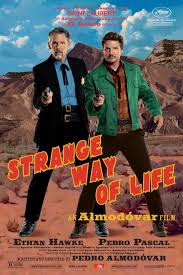
Strange Way of Life

This short film (30 minutes) by acclaimed director Pedro Almodovar is so good that the only criticism I can lob at it is that it's too short. Strange Way of Life stars Ethan Hawke and Pedro Pascal as two men who reunite 25 years after sharing a brief fling in the wild days of their youth. But the reunion isn't entirely happy. Silva (Pascal) is back in town to protect his son, accused of murdering a woman who happens to be Jake's (Hawke) sister-in-law. Also, Jake is the sheriff. 

As with all of Almodovar's films, Strange Way of Life is melodramatic, beautiful, and unabashedly queer. It's just too dang short--I would love for this to be a feature-length film! 

Strange Way of Life is currently streaming on Netflix if you want to give it a watch. 

Grade: B+

***

Ripley (TV series)

Based on the novel The Talented Mr. Ripley by Patricia Highsmith, some folks were skeptical of this 8 episode miniseries, which was commissioned by Showtime and then sold to Netflix--which means that it's a higher-quality series than you usually see on Netflix. The skepticism centered mostly on the casting of Andrew Scott (best known as "Hot Priest" from Fleabag) as Tom Ripley. Some felt that Scott was too old to play Tom Ripley, but to my mind there's no "rule" that Tom has to be in his 20s for the plot to work. Johnny Flynn (age 41) plays Dickie Greenleaf, so the two leads are not too mismatched in age anyway.

Filmed in gorgeous black and white, Ripley follows Tom, a scam artist living in New York who is contacted by Herbert Greenleaf (Kenneth Lonergan), a wealthy man who believes that Tom is friends with his son, Dickie. Dickie has been living in Italy for years, doing very little with his life (at least as Herbert sees it) and Herbert wants to pay Tom to go to Italy and convince Dickie to come home to New York. Of course, Tom jumps at the opportunity for a free vacation on Papa Greenleaf's dime. He heads to Italy, knowing nothing of the language and customs, finds Dickie and slowly integrates himself into the lives of Dickie and Dickie's girlfriend, Marge (Elle Fanning). 

If you are familiar with The Talented Mr. Ripley, you know what happens next. For those unfamiliar, I'll just say that Tom very quickly wears out his welcome and doesn't take too kindly to the idea that it's time for him to go back to New York.

I found myself absolutely riveted by the series, especially the second half. I LOVE Anthony Minghella's film The Talented Mr. Ripley, which stars Matt Damon as the titular character. And while I still think the film is superior, I was incredibly impressed with this series and some of the interesting choices it made. Scott plays Tom Ripley as more of a sociopath than Damon did, which leads to some deeply unsettling scenes. Eliot Sumer, the child of Sting and Trudie Styler, plays Freddie Miles (Philip Seymour Hoffman played Freddie in the film version), a friend of Dickie's who becomes very suspicious of Tom. I loved Sumner in this role--they captured Freddie's suspiciousness and smugness so well. 

If you love mystery and noir, you'll probably enjoy Ripley. The cinematography alone makes the series worth checking out.

Grade: A-

***

We Were the Lucky Ones (TV series)

Based on the novel by Georgia Hunter, We Were the Lucky Ones follows a Polish Jewish family as they become separated during WWII and the events of the Holocaust. The Kurc family is made up of Sol and Nechuma, the parents; Halina, Mila, Jakob, Genek, and Addy (the siblings); and Adam, Selim, Bella, and  Herta (the spouses of the siblings). The series opens in 1938 with the news of Nazism and antisemitism on the rise in Eastern Europe, but no real fear from the well-to-do Kurc family who could never believe that their very happy lives could ever be disrupted.

Over the course of the series, we follow the various Kurc family members to various towns on Poland as well as Siberia, Casablanca, and Brazil as they try to outrun or fight against the Nazis (and the Soviets). We Were the Lucky Ones provides a glimpse into how the modern Jewish diaspora occurred. It also shows the many ways in which Jewish people fought back against Nazism, including passing as gentile, engaging in underground resistance, and even complying as best they could. The horrible truth is that it didn't matter whether they complied with increasingly horrific demands and it didn't matter if they "looked" gentile or learned gentile prayers--fascism only cares about crushing everything in its way. 

While the events of We Were the Lucky Ones aren't news to anyone with a modicum of knowledge about history, the show feels important as we watch our own version(s) of fascism play out in the United States and abroad today. It feels borderline taboo to reflect on antisemitism given the devastating war in Palestine and the brutal and violent actions of the Israeli government. But antisemitism is still alive and well and all ethnic, racial, and religious hatred and dehumanization is ultimately cut from the same cloth. The victims may be different, but the perpetrators all have that same thirst for power, cruelty, and control.

Grade: A-

Sunday, April 28, 2024

Challengers

I just got out of Luca Guadagnino's movie Challengers and raced home to start writing this. This is one of the most exciting, enthralling, and engaging films I've seen in a long time. The previews for this movie made it out to be "the Zendaya threesome tennis movie", which was enough to get my attention, but oh my god it's so much more. It's about relationships and power dynamics and competition and ambition.

The movie stars Josh O'Connor, Mike Faist, and Zendaya as Patrick Zweig, Art Donaldson, and Tashi Duncan. In 2006, close friends Patrick and Art have just graduated from a tennis academy and won the junior doubles competition at the US Open. At a party, they meet Tashi, an incredibly talented young tennis player whose star is rising. They're both attracted to her and invite her to their hotel room. She stops by and they all make out (yes, everyone has a turn kissing everyone), but before things go further, Tashi gets up tells them that whichever boy wins the match they're playing against each other the next day will get her phone number. They try to get her to reveal which one of them she actually wants to win and she says "I just want to watch some great fucking tennis."

Challengers moves back and forth in time, so you know that Tashi wound up marrying Art and they have a child together...despite having dated Patrick in college (he's the one who got her number). In 2019, Art is a professional tennis player and Tashi, having suffered a knee injury in college and never fully recovered, is his coach. Art is on a losing streak and his confidence is failing. Tashi signs him up for a Challenger event so that he can regain his confidence by beating players way less experienced/talented than he is. However, Patrick, who also had a career as a professional player but is now down on his luck and reduced to sleeping in his car, signs up as a wildcard in the same Challenger...and GUESS WHICH GUYS END UP PLAYING EACH OTHER IN THE FINAL MATCH!?!

As the movie bounces back and forth (much like a tennis ball) between the past and the present, we see the power dynamics shift constantly between the characters. While Tashi is the definition of an Alpha Female, Art and Patrick are never truly hapless victims. They thrive on competition, both on the court and in the bedroom. What amazes me is that despite the lies, mind games, and adultery that occur in Challengers, there always seems to be a feeling of sportsmanship between the characters. While it gets close to cruelty at some points (a conversation between Tashi and Art in bed the night before he plays Patrick in the Challenger is especially difficult to watch) it never really feels like anyone is kicked while they're down. Even Art, who would likely be called a "simp" or a "beta" or a "cuck" by the young folks these days doesn't really seem all that pathetic. Partially because he's a truly talented athlete and partially because Patrick, despite having more "alpha" swagger, is living a much more pathetic life at the time of the Challenger match. And while both men drool and compete over Tashi, they manage to hold their own as best they can. Tashi really is like a goddess in this movie and we're all (Patrick, Art, and the viewers) just living in her world. 

Challengers is about the power of desire. Hot, sweaty, stomach-churning desire. The kind of desire that makes you weep in frustration while never feeling more alive. No director is better at capturing authentic portrayals of desire than Luca Guadagnino. He blew me away with Call Me By Your Name, which was just so honest and sensual and heart-breaking. Challengers comes pretty close to giving me the same feelings I got from CMBYN. This beautiful mix of flirtation, sexuality, intelligence, power dynamics, and humor. And it couldn't have been pulled off with lesser talent. The complexity O'Connor, Faist, and Zendaya have to bring to this film to make it work is extraordinary. The balance they all need to strike to get the tone perfectly right is a tight-rope walk. If Tashi's character were any meaner or any less mean, it would all fall apart. If the two guys were either more aggressive or more pathetic, the movie would feel icky and sad. But they all hit their emotional marks with pinpoint accuracy, making Challengers fun and sexy as hell. This is cinema, baby!

Grade: A+

PS: the soundtrack by Trent Reznor and Atticus Ross is AWESOME.


Wednesday, April 24, 2024

Civil War

When I first saw the preview for Alex Garland's Civil War, I was like "haha, no thank you." The idea of sitting through a film about an alternative history of the United States where we end up in a contemporary civil war just seems a little...close to home? 

But as the reviews started coming in, promising that this isn't the movie you think it is, I got curious and went ahead and bought a ticket. I'm glad I did because Civil War is a powerful, gut-wrenching film that gives the viewer (well, this viewer anyway) a serious adrenaline rush that slicker action films juts cannot achieve. Watching this movie literally feels like being in the middle of a war zone. If you're triggered by the sound of gun fire and images of people callously being shot and killed point blank, don't see Civil War. 

The movie takes place in "modern times", but in a version of the United States where Texas and California have banded together to secede from the nation, leading to a civil war. Nick Offerman plays the President of the United States who is currently serving his third term--it isn't outright stated, but heavily suggested that he didn't win a fair election that third time. 

Civil War makes a point to not provide any information about what led to the current state of affairs. There is a brief reference to "the Antifa massacre", which would have happened about 20 years prior to the events of the film. And there is also a Florida alliance of some states in addition to the "Western Forces" of California-Texas. The point of this movie isn't the why of the war, but more of a commentary on the fact that humans will find a reason to kill each other no matter what. I'll return to this point in a moment.

The movie follows a rag-tag group of war photographers. Lee Smith (Kirsten Dunst) is a celebrated war photojournalist who works with Joel (Wagner Moura), a Reuters journalist. These two are old enough to have the experience and instincts to survive in the middle of a war zone while still being young enough to move quickly when they have to and survive on little sleep and a lot of stress. They plan to drive from New York to DC in the hopes of getting an interview with the President (a highly unlikely prospect). They'll have to take a roundabout way through West Virginia since many of the highways are inaccessible. 

Along for the ride is Sammy (Stephen McKinley Henderson), a veteran photojournalist and Lee's mentor, who wants to get close to the action while logically knowing his body is too old for this shit. Additionally, the very young, very inexperienced Jessie (Callie Spaeny), who all but worships Lee and has big dreams of becoming just like her, manages to talk her way into joining the group. Lee is skeptical, but reluctantly agrees to allow her to tag along as far as Charlottesville. 

Danger lurks everywhere on this road trip from hell. There is no rule of law anymore. The group stops to get gas (a scare resource--they pay "300 dollars, Canadian" for it) and the gun-toting gas station owners show Jessie and Lee two looters they have captured and strung up. They've tortured and beaten the men within an inch of their lives but haven't killed them yet. Jessie is horrified into silence. Lee requests to take the men's picture alongside their captor, who agrees. 

This scene gets to the heart of one of the major themes of the film: is it ethical to witness atrocities without intervening? That is the job of the war journalist, is it not? War photographers have to get really close to horrific things all while not taking steps to interfere. That seems deeply unethical, but if they tried to intervene, they would almost certainly be killed (and of course, many war photographers are killed in the course of their work). And if no one photographs war, then people don't see it. In order for care about war, they need to see what is happening--as up close as possible. But in order for people to get up close, they have to have a level of detachment for their own safety and sanity. 

Civil War is about the paper thin line of so-called "right" and so-called "wrong" in a world where those lines have been irrevocably blurred. The movie takes place in a society where people kill because others are killing them. They kill because there is no rule of law. They kill because they have a gun. Back to the point I made earlier about not needing a reason to be at war: there's a scene where the gang comes across a stand-off between two men who are trying to take out someone shooting at them from a distant house. They ask for context: what led to this stand-off? The men say "There's a guy who's shooting at us in that house. We're trying to shoot him. We're stuck." The absurdity of this ouroboros (we're shooting at him because he's shooting at us because we're shooting at him...) is both funny and sad. We're at war because we're at war. 

Garland has said that Civil War is an "apolitical" film, which is both sort of true and sort of not true. The movie isn't about MAGA vs. woke or conservative vs. liberal, but it still shows the human toll that war and violence take. We see that toll in the tired eyes of Lee and Joel--two people who have been at the center of so much pain and suffering and death that they've lost a part of their souls. Which doesn't mean they're bad people, just that they've needed to turn off their empathy to do their jobs...and to survive. War can kill you quickly, but it can kill you slowly too. 

Civil War is an "anti-war" movie, but I feel like it wears that mantle loosely. You can kind of read whatever you want to into the film. War enthusiasts could see it as a movie that argues for the necessity of war in order to gain freedom. Pacifists could see it as a commentary on the total senselessness of war. People can read Lee and Joel as complicit in the atrocities they photograph...or the only people willing to show others the harsh realities of war. What you take away from the film is very much up to you. 

Grade: A-

Sunday, April 7, 2024

Stuff I watched in...March, 2024

American Fiction

I wanted to like this satirical comedy, directed by Cord Jefferson, more than I actually did. Based on the novel Erasure by Percival Everett, the film follows Thelonious "Monk" Ellison (Jeffrey Wright), a very intellectual writer and professor who comes from an upper-middle class family of equally high achievers. Monk also happens to be Black. So when his agent tells him that publishers keep turning down his latest manuscript because they want a "Black book", Monk says "They have a Black book. I'm Black and it's my book." What these publishers really want (at least in Monk's mind) are tales of racial woe: absent fathers, police brutality, drugs, violence...and Black vernacular. Monk writes books that are updated versions of ancient Greek tales--no mention of race and certainly no "racial politics".

So, as a joke, Monk writes a "Black book" filled with slang, cussing, and lots of drugs and violence. The publishers eat it up. If this premise sounds a bit familiar, it's probably because Spike Lee did it already with Bamboozled. And, I mean, it's also sort of the premise of The Producers, as well. Monk tries to tank his own book by pretending the author (he uses a nom de plume) is a wanted felon. He also insists on renaming the book "Fuck". But everything he does just makes the publishers write bigger and bigger checks! And then the book sells like hotcakes! And then it gets nominated for an award!! And Monk is on the panel to judge the awards!!! 

American Fiction is good, and it has some pretty funny moments, but it wasn't quite as razor sharp as I was hoping it would be. The thought that kept popping into my mind was the term "respectability politics"--basically, the idea that Black folks need to be "respectable"--educated, well-dressed, well-spoken, mannerly--in order to be worthy of equal rights. This is an idea that was and still is accepted and encouraged among some Black people (and, of course, white people). Monk believes in respectability politics, and he believes in colorblindness (that his writing, not his skin color, should matter). And he's not completely wrong. There are lots of Black people who don't fit in with the stereotypes we have historically associated with Black lives. And their stories matter, too. And Monk's skin color shouldn't matter and he shouldn't be expected to write any particular type of book just because he's Black.

But the message feels a bit muddled. Monk fights with his girlfriend when he sees her reading a copy of Fuck (of course, she doesn't know he wrote it since it's written under a pen name) and then realizes he was a total jerk. He talks to the author of a popular book written with heavy AAVE (African-American Vernacular English) that features downtrodden characters and she reveals that she did a lot of research for the book. And points out that a lot of Black people are downtrodden and their stories matter. Basically, Monk realizes that maybe his point of view isn't the end all, be all. 

And I haven't even gotten to the B-plot, which is about Monk's family going through some very difficult times together, in particular with dealing with Monk's aging mother.

Writing this all out, I feel pretty good about giving American Fiction a B+ grade: it's good. Very good, even. But there was something keeping it from being great. Like I said, it wasn't quite as funny or quite as satirical as I was expecting. But it's a solid film with excellent acting. 

Grade: B+

***

Anatomy of a Fall

It's really interesting talking to people who have seen Justine Triet's courtroom drama and asking "so do you think she did it?" Anatomy of a Fall is about a man who falls to his death and the legal battle to decide if his wife, Sandra (Sandra Huller), pushed him. 

The 2.5 hour long film goes into every detail: the height of the window sill out of which he fell (or was pushed), the pattern of the blood spatter, whether the couple's blind son, Daniel (a phenomenal Milo Machado-Graner), heard them arguing before he went on a walk with his dog. At first, the evidence for Sandra's guilt seems to be mainly based around the blood spatter and also the fact that not only did Sandra and Samuel (Samuel Theis) fight, but he recorded a particularly violent fight they had the day before he died. Sandra's lawyer, Vincent (a very 'zaddy' Swann Arlaud), thinks Samuel might have committed suicide and, sure enough, Sandra remembers an incident from a few months earlier that could have been a suicide attempt.

I really enjoyed this movie, but I felt like somewhat of a dum-dum watching it for multiple reasons: first, I don't watch a ton of legal thrillers and shows so I don't think I have a solid grasp on courtroom procedure in the first place. Second, even if I did have a solid grasp on *American* courtroom procedure, this is a French film and boy do they seem to do things differently over there. It felt like there was a shit ton of wild speculation happening in the courtroom. Speculation about Sandra having an affair with a woman on the basis of...Sandra being bisexual. At one point the prosecutor pulls out a bunch of novels Sandra wrote and points to "evidence" of a desire to kill her husband written in her fiction. I don't know remotely enough about French law to know how much as this is how it really goes down in courtrooms there and how much was exaggerated for dramatic (and comedic) effect, but it was definitely entertaining!

I was riveted by this movie, although I'm not sure it would hold up well upon rewatching. It would still be good and feature good acting, but the enjoyment mostly comes from the revelations that unfold during the course of the film. I will say that there is a banger of a scene near the end featuring Milo Machado-Graner, who was probably about 13 or 14 at the time Anatomy of a Fall was filmed. He is a remarkable young actor and does a fantastic job in this film.

Grade: A-

***

Lovely, Dark, and Deep

The premise of this horror film was like catnip to me: a ranger at a national park searches for a missing teenage girl and *sPoOkY sHiT hApPeNs*. I love "lost in the woods" scary stories and conspiracies about the suspiciously high number of people who go missing in national parks.

Sadly, the film didn't live up to my expectations. Georgina Campbell (best known for Barbarian) plays Lennon, a backcountry ranger starting a job at Arvores National Park (a fictional park). Lennon doesn't like other people very much and it seems like a post working in the deep woods is perfect for her. But Lennon also has personal reasons for choosing this line of work: as a young girl, her sister went missing in Arvores and was never found. Lennon plans to systematically search as much of the backcountry as she can.

Her quest is interrupted when a teenage girl is reported as missing. Despite orders to remain at her post, Lennon searches for the girl and finds her. Her supervisors seem peeved that Lennon searched for the girl despite the fact that it all worked out in the end. It turns out that sometimes the woods takes people and don't want to give them back...and anyone who interfers has to pay the penalty. 

The idea that the many people who go missing in national parks has a supernatural explanation is an intriguing one and plays into the natural fears humans have about the deep, dark woods. But Lovely, Dark, and Deep fell really flat for me. It wasn't that scary. The second half feels like an extended dream sequence and I don't like dream sequences in movies in general. Campbell is fine but not nearly as good as she was in Barbarian. Overall, meh. I'll stick with scary (fictional) Reddit stories about national parks.

Grade: B-

***

Blazing Saddles

I had been meaning to see Blazing Saddles (having seen most of Mel Brooks' other movies) and it just so happened that I recently stayed at an AirBnb with a large DVD collection that contained an UNEDITED copy of this comedy classic. A full six minutes longer than the edited version on Netflix! 

I was...less than impressed. Not because of the racial humor because 1) this movie came out in 1974 and 2) it's making fun of the racists. It was just...not that funny?! I know that this is a beloved classic for many people and it does have some good lines ("You know....morons.") and great scenes (Madeline Kahn's song "I'm Tired" as Lili von Shtupp), but overall I found it awkwardly paced and not very memorable. It's no The Producers, that's for sure. Cleavon Little is really good, though! Very charismatic. Gene Wilder, well...it's not his best role. 

Still, a Mel Brooks movie is never unwelcome and I had fun watching it. If anything, watching Blazing Saddles makes me want to rewatch Young Frankenstein and The Producers. So, I'm glad I watched it if only for the cultural references, but I can't say it'll be a regular rewatch for me. 

Grade: B

***

The Lives of Others

I was blown away with this 2006 German drama when I first saw it over a decade ago and upon rewatching it I remain blown away. The film takes place in 1984 in East Germany, a time when the Socialist government heavily surveilled its own people. Ulrich Muhe plays Gerd Wiesler, a Stasi Hauptmann who truly believes in his work and is great at getting so-called enemies of the state to rat out their friends and family. Wiesler isn't a sneering, evil villain--he is a quiet, boring man. But he believes in and is good at his work. 

Hoping for a promotion, Wiesler's superior, Grubitz (Ulrich Tukur), assigns Wiesler to spy on playwright Georg Dreyman (Sebastian Koch). Turns out that the Minister of Culture, Bruno Hempf (Thomas Tieme), is having a less-than-consensual affair with Dreyman's girlfriend, Christa-Maria (Martina Gedeck) and hopes that if they find dirt on Dreyman, he can get his romantic rival out of the way. 

Wiesler doesn't know about the "affair" between Hempf and Christa-Maria at first (and I say "affair" because it's clear she hates the man, but feels like she can't say no to him) and when he finds out that he is spying on Dreyman not for "pure" reasons but because some fat cat in the government wants to get his rocks off, he starts doubting the entire operation. He starts...caring...about the people he is spying on. He starts interfering with the job and hiding information from his superiors. 

The Lives of Others is a deeply emotional film without being overly sentimental or schmaltzy. It has a few cheesy moments, but generally speaking it is subtle while still packing a powerful wallop. The acting is excellent across the board, but Ulrich Muhe is a standout as the morally conflicted Wiesler who has given his whole life to the State only to realize...the State is corrupt! He's not a naive man, he's just seeing clearly for the first time. I feel like most of us can relate to Wiesler on some level: believing so strongly in some ideal or institution and then seeing the failure of that ideal or institution in practice and not knowing what to think. Despite being a member of the East German Secret Police, Wiesler actually has a moral center. He's able to see the corruption because he himself is not corrupt...even though he works for the people history would (rightly) deem "the bad guys". And so he goes against all he believes and even puts his own job and freedom in jeopardy to help the people he was ordered to spy on. Don't we all dream of doing the right thing even when it costs us everything? But so few of us will. 

Something I've always found amusing about The Lives of Others is that in 2009, The National Review Online named it the "best conservative movie" of the last 25 years. Of course, conservatives were very different in 2009 and actually had some taste. The reason it was considered "conservative" is because the film is, of course, against Socialism. As it should be, given that East Germany was not a fun place to live. The government surveilled the population, punished those who spoke out against the government, and heavily censored media and culture. The film would probably be considered "woke" by The National Review today, but I like to think that The Lives of Others is SO good and SO powerful that neither conservatives nor liberals could deny it. 

If you haven't seen it, give The Lives of Others a watch. It's simply a masterpiece of a film. 

Grade: A+

***

Road House (2024)

Alright, so full disclosure: I haven't seen the 1989 action flick Road House starring Patrick Swayze, may he rest in peace, despite the movie being on basic cable every single day when I was a kid. My friends tell me it's great and I should watch it. Maybe I will.

The same friends had me over to watch Road House, the 2024 remake starring Jake Gyllenhaal, and boy howdy, let me tell you: it was bad. But kind of a good bad, you know? 

Let me set the scene: it's 9pm, which is way later than when I typically start a movie. But I'm all hepped up on Easter candy because earlier I watched Willy Wonka and the Chocolate Factory with my friends and their two kids who hadn't seen it before. We all ate a ridiculous amount of pizza and candy during Willy Wonka (as one does). They come back from putting their kids to bed and we start the movie. Two minutes in, I'm thinking "this movie will be horrible". There's just something about it. The way the characters talk. The way the movie feels too slick for a film about men beating the shit out of each other. Something's off. 

About 30 minutes in, I figure out what's wrong with it. Road House "feels" like a romantic comedy. It takes place in this small town in the Florida Keys where everyone knows each other. The main character, Dalton (Gyllenhaal), meets a young, quirky girl right when he gets into town who refers to "Fred", a tree that grows in the middle of the highway (and is real, by the way). Everyone makes these soft, corny jokes that barely qualify as "jokes". And when the bad guys show up, they are just...I don't know how to explain it...they're like bad guys in an evangelical Christian movie. They're like what an out of touch, sheltered person would think "bad guys" are like.  

It was like someone at the movie factory accidentally spilled "violent action flick" into the "small town Hallmark romance" mold. It was almost uncanny valley-esque.

I almost gave up on Road House. The movie is over two hours long. It was late. I was tired. But my friends convinced me to hang in there. And boy I'm glad I did because the last 45 minutes of this movie are INSANE. We finally get some real action and some real violence, but it's all so over-the-top that we were practically screaming with laughter. I'm talking speedboats crashing directly into each other at top speed and exploding kind of action. I'm talking Jake Gyllenhaal and UFC star Conor McGregor stabbing each other with random pieces of wood type action. There was a man on fire on a sinking yacht and Gyllenhaal punches him into the ocean! WHAT IS THIS MOVIE!? 

And yes, the hated song "Kokomo" by the Beach Boys is featured on the soundtrack.

Road House is an absolute mess. It's simply a terrible movie by any measurable standard, but that doesn't mean it's not entertaining under the right circumstances. Those circumstances involve substances (in my case, too much Easter candy. But if you imbibe, this is definitely a movie to get drunk or high to), friends, and heckling. God help the poor bastard who watches this movie sober and alone. 

Grade: C+

***

Wonka 

After rewatching one of my all-time faves, Willy Wonka and the Chocolate Factory (which I have reviewed elsewhere on my blog), I decided to give Paul King's Wonka a shot. I went in with low expectations because 1) the best Wonka is Gene Wilder and that will never change and 2) the movie just looked plain bad in the previews. Well, I'm pleased to say that it was fine. Pleasant. Elicited sensible chuckles from me. 

Both Mel Stuart's 1971 film and Tim Burton's Charlie and the Chocolate Factory are based on the book Charlie and the Chocolate Factory by Roald Dahl. Wonka is meant to be a prequel, so there are nods to the book and previous films, but Wonka is mostly doing its own thing here. Who was Wonka before he was the reclusive mad genius who invites children to his factory and dispatches them one by one? A rather optimistic and altruistic young lad. 

And this is my biggest issue with Wonka: it's not dark enough. Or, more specifically, this version of Willy Wonka, played by Timothee Chalamet, is not dark enough. Charlie and the Chocolate Factory is a dark book. Roald Dahl is a dark author. Gene Wilder actually looks crazy in the 1971 version and Johnny Depp is just straight-up creepy, so he kind of works in the role too. I love Timothee Chalamet, but he doesn't have that dark sarcasm with a hint of gleeful insanity that the Wonkas who came before him had. 

He's also...not very funny. Chalamet is great in serious roles, but I don't think he's really honed his comedic chops just quite yet. So, Wonka gives us a version of Willy Wonka who is basically just a really sweet guy who is good a making chocolate. I guess you could argue that this movie takes place before Wonka became a weirdo who may or may not murder children for fun, but I think that Wonka must have always had a bit of darkness within him and you only see sweetness and light in the Chalamet interpretation of the character. 

That said, the movie itself has some decent laughs. Wonka shows up in an unidentified generically European country with a few coins in his pocket and a few tricks up his sleeve, ready to make him name as a chocolatier. Unfortunately, he immediately runs afoul of the "Chocolate Cartel": a group of candymakers who have a tight monopoly on the chocolate business and pay off the cops in chocolate to run any competition out of town. Young Willy also ends up becoming an indentured servant to one Mrs. Scrubitt (Olivia Colman, never not a delight), a woman who runs a boarding house and basically scams the naive lad into owing her a great debt. I really didn't think I'd see slavery in a children's movie about a candymakers, but here we are. Maybe that's where Willy got his idea to enslave the Oompa Loompas!

Wonka meets Noodle (Calah Lane), an orphan who was "adopted" (enslaved) by Mrs. Scrubitt and together they come up with a plan to sell enough chocolate to earn the money to free themselves and all the other poor saps whom Mrs. Scrubitt has working in her laundry. 

Paul King is the director of Paddington and Paddington 2, which is apparently the greatest film of all time (according to the movie group I'm a member of on social media). Even though I found Wonka to be just ok, it really does make me want to check out the Paddington movies. So, that's a win. Wonka is a cute movie and should be fun for the whole family. You might even shed a tear or two. But this Wonka is very much a Paul King creation and not a Roald Dahl creation. 

Grade: B