Wednesday, July 22, 2015

Female Trouble

Books: Dietland, The Girl on the Train

Sarai Walker's Dietland and Paula Hawkins' The Girl on the Train feature difficult heroines who start off weak and gradually gain strength throughout their respective stories.

In Dietland we follow Plum Kettle, a woman of about 30 who weighs 300 pounds. Plum has been overweight her whole life and copes by ignoring the stares and rude comments of strangers, obsessively dieting, and fixing her hopes on the life she will have after she undergoes gastric bypass surgery and becomes the "real", thin version of herself. After circumstances throw her into the path of Verena Baptist, the daughter of Eulayla Baptist, a woman famed for creating the "Baptist diet plan", Plum stars to rethink her entire approach to life. Verena, who rejected her mother's fraudulent and unsafe diet empire, promises to give Plum a check for $20,000--to use on the surgery, or anything else--if Plum follows Verena's "new Baptist plan", which includes standing up to strangers who stare at her and buying attractive clothes that fit her.

This description of Dietland probably makes the book sound like it's a feel-good beach read about accepting one's body. It's not. The last thing it is is touch-y, feel-y. There is a secondary plot that involves what can only be described as a feminist terrorist group that goes by the name "Jennifer" (because the name is so common--it could be "any woman in your life"). This group does things like kidnap rapists, torture them for months, and then drop their bodies out of airplanes. They blackmail British tabloids into replacing images of nude or scantily-clad women with images nude, aroused men. They kidnap an imam and, on television, force him to tell the men of his religion to pour acid into their eyes rather than force women to cover their heads and bodies. You get the picture.

 As "Jennifer's" antics escalate, Plum is taken under the wing of a group of women (including Verena) who make up Calliope House--a feminist collective dedicated to creativity and helping other women. Plum gets angrier and more aggressive as the story progresses. She gets herself in dangerous confrontations with men who call her a "fat bitch". She starts stealing.

While the story is about Plum's transformation from beaten-down fat girl who loathes herself to a freer woman who can walk the streets unashamed, there is still a heavy note of sadness weighing down this novel. Plum finds her chosen family in the women of Calliope House, but she doesn't find acceptance in the world at large. In fact, Plum's self-acceptance does not arise in spite of the world's hatred of her body, but because of it. By being 300 pounds, Plum figures that she gets to see people's true selves: if she were skinny, people who treat her decently while treating fat women like the scum of the earth. Plum finds that she would rather be fat and hated that well-liked by the very people who get their jollies by humiliating fat people. It's a dark--if very truthful--thesis to a difficult, entertaining, complicated book. Also of note: men barely exist in Dietland except to humiliate or reject Plum. While she finds her band of sisters, there are no men who also reach enlightenment. It's a very separatist perspective, and one I don't entirely buy into.

Likewise, The Girl on the Train features an absolute mess of a heroine. Rachel is in her early-thirties, divorced, overweight, alcoholic, and just incredibly sad and lacking in personal direction. As she rides the train every morning and evening, she makes up a story about the lives of a beautiful couple whose house she can see from the train--she dubs them "Jess" and "Jason". But then one day she sees an indiscretion that explodes her perfect view of the couple and she begins an obsessive--and dangerous--investigation to find out what's really going on. Her sleuthing is complicated by the fact that she has a tendency to black out for hours at a time when she's drinking.


The Girl on the Train has been compared to Gillian Flynn's Gone Girl for obvious reasons: they both tell the same story from multiple perspectives, they both have unreliable (and "unlikeable" protagonists), they both involve themes of betrayal, violence, and the dark side of marriage. I personally think Gone Girl is the better book--it's sharper, better written. The Girl on the Train gets a bit repetitive after a while, and Rachel is bland and gray compared to the acidic glow of Gone Girl's Amy Dunne. But The Girl on the Train is highly entertaining and genuinely keeps you guessing. It doesn't reveal all the cards until the very end. It's also very realistic in its portrayal of alcoholism. Author Hawkins isn't afraid to have Rachel vomit, piss herself, cry, fuck up over and over. You never hate her, but you seriously pity her--which is worse, in some ways. Hawkins has big, brass ovaries for never turning Rachel's alcohol problem into something sexy and glamorous. Unlike other hard-boiled fiction with detectives or PIs who keep a bottle of rye along with a handgun on them at all times, this amateur investigator's antics are very sad and unsexy to read about.

Neither Dietland nor The Girl on the Train hit the sweet spot 100% of the time for me, but they're both really good, solid reads. Dietland is especially fascinating in its uncompromising anger at a society that treats women's bodies like public property, to be jeered at, or jacked off to, depending on how "hot" said body is. It was a cathartic book, if nothing else. The Girl on the Train is the perfect read for, well, a train ride (or plane or car ride). It sucks you in and leaves you turning pages for hours. So although neither book is perfect, they're both worth your time.

Dietland: B+

The Girl on the Train: B

Monday, July 6, 2015

Dirty Dancing

Movies: Magic Mike XXL

Something happens when something out there in popular culture excites women en masse --particularly if that something is related to sex. People sit up and pay attention. They write articles. They start discussions at the water cooler at work (or the Starbucks). They ask, "Is this what women want?" And, a lot of the time, they laugh at whatever *it* is.

Take the infamous Fifty Shades of Grey. A book that sold millions of copies. What happened when it went viral? Katie Rophie wrote an article in Newsweek about how the popularity of the novel proved that women--particularly modern, empowered women--wanted to be ravished by a strong, stern man at the end of the day. Articles and blog posts trumpeted how the book "saved marriages" by giving couples the fuel to "spice things up" in the bedroom (I always thought it was weird how few of these articles mention the big M--masturbation. Surely more women just read the book in private and did their thing than actually incorporate the acts described between its covers to their life under the covers). And, more than anything else, people laughed at it. They laughed at it on the Internet, on late night talk shows, in daily life.

Now, I'm not saying that Fifty Shades doesn't deserved to be laughed at (it does, as it's a piece of shit). But I think it's interesting that a book that certainly got a lot of women hot and bothered so quickly became the butt of everyone's joke.

Steven Soderbergh's singular film, Magic Mike, was released six months after the final book in the Fifty Shades triology was released. Another pop culture phenomenon that seemed ripe for mockery, Magic Mike upended everyone's expectations by actually being a good movie. It was one of my favorites of 2012, and I'm gonna defend that goddamn movie until my dying day--it's a great fucking film, made even better by the rock bottom expectations most people had going into it.

But even though Magic Mike got critical accolades, people still treated it like a joke and a silly thing for women to enjoy. Even though the movie is about male friendship, first and foremost. I think people are incapable of taking a movie about male strippers (or, if we're being honest, strippers of any gender) seriously. People see Channing Tatum humping a woman's face to the strains of Ginuwine's "Pony" and they can't think of anything more ridiculous. Though, if given truth serum, I think most heterosexual women would admit that being dry-humped by whatever perfect male they have in their mind is a more than appealing thought.


All of this brings us to Magic Mike XXL, the sequel to Magic Mike that is exactly what people thought the original film should have been. Under the guidance of a new director (Gregory Jacobs), the plot has been stripped down (HAR HAR HAR) and the deeper emotions of the original buffed (GET IT?) out, leaving nothing but oiled up hunks grinding on a parade of women of all shapes, sizes, colors, and ages.

Not that I'm complaining.

Magic Mike XXL is a fantastically entertaining sequel, although it's certainly nowhere near as "good" as its predecessor. XXL takes place three years after the events of the original film. Mike Lane (Tat-yum) owns his own furniture design start up just as he dreamed of in the first movie, and he has left stripping to work on his business full time. When the boys--Ken (Matt Bomer), Tito (Adam Rodriguez), Tarzan (Kevin Nash), and--my personal favorite--Big Dick Richie (Joe Manganiello, who takes a much-deserved center role in this film)--contact Mike about performing at a stripper convention in Myrtle Beach, the man can't help but take the opportunity to try out some of his magic moves again.

The movie explains the absence of emcee Dallas (Matthew McConaughey), fellow stripper The Kid (Alex Pettyfer), and Mike's love interest, Brooke (Cody Horn), in a couple throwaway lines of exposition. Who cares about those losers? Onwards and upwards!

Magic Mike XXL is a typical road trip movie. People try to get to a destination and stop and have adventures along the way. There are a lot of memorable scenes that wouldn't be out of place in a porno: the guys stop at a private club in Savannah called "Domina" run by HBIC Rome (Jada Pinkett Smith); the guys end up at the house of a middle-aged, divorced woman (Andie MacDowell) and a group of her friends as they get plastered on expensive wine; Big Dick Richie has a great scene cheering up a lonely gas station clerk. Etc, etc. And then they finally get to the stripper convention and create the act of a lifetime--all new dance numbers to represent the real men underneath all those abs and bedroom eyes.

Magic Mike XXL works because it completely, unashamedly owns its corniness...and it's horniness. This is a film that makes some noise about how women should be worshiped as the goddesses they are and how all women are beautiful--while also exacting a strict standard for how the men in the film look. I kind of like that. It's the reversal of all those comedies where a homely Kevin James-type ends up with Rosario Dawson--because he has inner beauty, dammit! In Magic Mike XXL women get to have the inner beauty and men are all but required to have the outer beauty. It's not fair, it's not right...but it's titillating in its unserious subversiveness.

Eh, I'm probably trying too hard to find the deeper meaning in a film that has very limited depth. Magic Mike XXL is pure spectacle: it's fun, it's funny, it's campy, it's sexy. And it also makes me want to go back and watch the original, which was all of the above adjectives plus quality. The two Magic Mike's work in perfect symbiosis: when taken together, they have the body, the brains, and the heart.

Grade: B


Friday, July 3, 2015

All Thumbs

Movies: Life Itself

When I was in 10th grade, my career goal was to be an "entertainment journalist". A fervent reader of Entertainment Weekly since the late 1990's, my dream job was to watch and review movies and get paid for it.

Well, the world has changed a lot since I was 16. With the advent of the Internet, blogs, and social media, everyone has the ability to critique everything, from films and television shows, to vaccines and the right for gay people to adopt children. Everyone has a voice and an opinion--and we all know that this is both a blessing and a curse.

But society has changed in another way: the idea of "expertise" has changed. With Wikipedia, the average Joe or Jane on the street has the right and ability to add their expert knowledge to the flowing stream of publicly available information. Again, this is a blessing and curse: on the one hand, we have more access to information than ever, AND we aren't bound by old-fashioned (and racist, sexist) notions of who qualifies as an expert. But on the other hand, the idea that everyone and no one is an expert leads some to lose faith in the actual experts and professionals. For example: losing faith in doctors and evidence-based medicine has led to measles, mumps, and whooping cough outbreaks.

All this is to say that there was a time not too long ago when a few individuals could achieve fame and (relative) fortune simply by giving their opinion about the movies. Roger Ebert was one of those individuals, and boy did he deserve his fame and (relative) fortune. If you've ever read Ebert's reviews (they're all archived here, along with current reviews from writers carrying on Ebert's torch), you'll find that they are, to a one, thoughtful and funny. Reading his reviews is like listening to your clever, irreverent friend describe a movie he just saw. In fact, when I started this blog, I modeled it after the way Ebert wrote his reviews: he went beyond basic description and tied films to the realities of our culture (for example, his review of Raging Bull opens with a meditation on the "Madonna-whore" complex some men have). This makes sense, as cinema is not just entertainment, but art. And the purpose of art is not simply to be beautiful or ugly, but to reflect beautiful and ugly things in our culture. Ebert understood this, and his deep, passionate, unquenchable love for the movies--and, indeed, life itself--shines through his reviews in a way you don't see too often.


Life Itself is a documentary about Ebert based on his autobiography of the same title. Though it covers all the highlights and achievements in Ebert's life (his Pulitzer win in 1975, his decades-long partnership with film critic Gene Siskel [and their 'frenemies'-style relationship], his late in life marriage to Chaz Hammelsmith), Life Itself is notable for its lengthy scenes set in the hospital near the end of Ebert's life. Throughout the early 2000's, Ebert underwent multiple surgeries to remove cancerous tissue in his neck and jaw. By 2006, most of his lower jaw had been removed and he could no longer speak or eat without the assistance of a tube. This documentary is, in my opinion, incredibly brave (as is, obviously, Ebert) to show the full extent of Ebert's physical appearance and daily challenges near the end of his life. Sensitive viewers should be warned: it's not pretty. Ebert's jaw is gone, leaving behind the skin that would have covered the absent jawbone. It's gruesome to watch at first, but as the documentary progresses, you realize that there's still a twinkle in Ebert's eyes, and he's still quick to smile and make a joke (albeit with the use of a computer) and that he is still complete, still whole, despite his many health setbacks. It's a wonderful--and heartbreaking--thing to see. Especially since Life Itself takes us right to the brink of Ebert's final days.

Even if you're not very familiar with Ebert's work (and to be honest, I haven't read as much of his writing as some of my more gung-ho movie friends), Life Itself is a fascinating, heart-wrenching, and joyous documentary that celebrates the life of an imperfect, unusual, whip-smart man who, with a "thumbs up" or "thumbs down", had the ability to make or break a movie. Or at the very least, convince you to go see it. He influenced multiple generations of film lovers, including myself, with his writing. Life Itself pays him a well-deserved tribute.

Grade: B+

Wednesday, June 17, 2015

Extra Entertainment

Movies, TV Shows: Slow West, Pitch Perfect 2, Would You Rather, Winnebago Man, Miss Fisher's Murder Mysteries

I've been on a reviewing bonanza lately, but I still have a few miscellaneous films (and a TV series thrown in for variety!) to briefly review. Please enjoy!

Slow West

It's been two months since I saw Slow West at the Nashville Film Festival, so it's not exactly fresh in my mind. However, I do remember liking how director John Maclean combined traditional elements of western films with dreamlike scenes and settings, as well as wry humor in the film's dark moments (I have to reveal just one: when a literal jar of salt accidentally spills into one character's fresh bullet wound--couldn't help but chuckle at that). Consider it a Clint Eastwood film by way of Wes Anderson.

The plot is simple enough: 16 year old Jay Cavendish (Kodi Smit-McPhee) travels from Scotland to the American frontier in search of his love, Rose (Caren Pistorius). Jay isn't remotely cut out for the violent world of the West and comes across taciturn outlaw Silas (Michael Fassbender). He pays Silas for protecting him on his journey. Unbeknownst to Jay (but beknowst to Silas), Rose and her father have bounties on their heads...and Jay is leading the amoral Silas right to them.

Its mordant sense of humor and interesting camera work sets Slow West apart from more traditional westerns, and its climatic final scene is worth the price of rental alone. Slow West is a good film to check out even if you don't really care for westerns.

Grade: B

***

Pitch Perfect 2

Like most sequels, Pitch Perfect 2 is basically the same as Pitch Perfect 1 only...less than. The sequel finds a cappella superstars the Barden Bellas in the middle of a humiliating scandal (you've all seen the preview: Fat Amy's leotard rips, revealing her aca-muff during a show attended by President Obama) that gets them kicked off the America aca-circuit. However, they discover a loophole that allows them to participate in an international competition. Beca (Anna Kendrick), Chloe (Brittany Snow), Fat Amy (Rebel Wilson), and the others have to overcome their differences as well as their busy schedules (Beca is interning at a record production company; Fat Amy is busy hooking up with Bumper [played by the divine Adam Devine]) to beat the competition.

Pitch Perfect 2 has its moments. The best scene, for my money, is when the Bellas and a bunch of other groups participate in an aca-off at a party hosted by an eccentric millionaire, gloriously played by David Cross. We saw basically the same scene in the first Pitch Perfect, but it's what the audience wants, dammit! And I respect long-time actor, first-time director Elizabeth Banks for giving us what we want.

However, Pitch Perfect 2 does not have the emotional resonance of the first film and generally feels like diminishing returns. It's good fun for fans of the first Pitch Perfect, but will only be modestly amusing for others.

Grade: C+

***

Would You Rather

Would You Rather, a horror film I inexplicably chose to watch on Netflix right before bed the other night, is essentially the same movie as Cheap Thrills, which I reviewed a couple months ago. However, where Cheap Thrills had a sick sense of humor, Would You Rather has no sense of humor, making it a sadistic drag rather than a guilty pleasure.

Protagonist Iris (Brittany Snow) is in major debt taking care of her ailing younger brother. Strange millionaire Shepard Lambrick (Jeffrey Combs, absolutely chewing the scenery) invites her, along with a bunch of other people who need money for various reasons, to his mansion with the lure of potentially gifting them money if they win a game. Apparently none of these people have ever seen a horror film because then they would know that if a millionaire lures you to his house with the promise of money, you'll probably end up dead or maimed.

The group, including characters played by veteran actress June Squibb and adult film star Sasha Grey, is forcibly subjected to a deadly game of "would you rather", which starts with contestants choosing to administer a painful electric shock to themselves or to their neighbor and gets way, way worse from there. The central question of the movie is "how far would you go to get the money you need/help your loved ones?" which was also the central question of Cheap Thrills. The only difference is that in Would You Rather the characters are held captive at gunpoint and forced to "play" the "game". So the "plot" is basically a vehicle to show people stabbing little old ladies with ice picks and being drowned in barrels of water.

A nasty little piece of work, Would You Rather is a psychological horror film with no horror, no payoff, and no point.

Grade: D

***

Winnebago Man

I didn't really know what to make of Winnebago Man, a documentary about Jack Rebney, the reluctant "star" of some outtakes from a Winnebago sales video that went viral (first on the underground "found footage" circuit and later on YouTube) because of Rebney's f-word-laden outbursts. Director Ben Steinbauer discovered the clips and became obsessed with finding the man behind them. When he finally does contact Rebney, who has essentially become a recluse living in the mountains in northern California, he is disappointed to find that Rebney barely seems to remember the Winnebago video and couldn't care less that he is an Internet superstar.

...but then Rebney calls Steinbaur a week later wanting not only to change his image as "the angriest man in the world" but to get his (admittedly, curmudgeonly) opinions about how the world is going to hell out to an audience. What follows is a strange dance between Steinbauer and Rebney. It's very difficult at times to tell if Steinbauer is taking advantage of Rebney, who, though extremely intelligent and verbose, is not exactly in touch with the modern world and social media. It's also difficult to tell what, exactly, Rebney wants. He claims he doesn't care what people think about him, yet he clearly enjoys spouting his opinions (they aren't even that heinous--for example, he hates Dick Cheney) to anyone who will listen.

At times during Winnebago Man I felt icky because it seems that we are meant to laugh *at* Jack Rebney, not with him. However, the final act of the documentary, in which Rebney attends a screening of the clips and is met with praise and applause by his fans, tugs hard at the heart strings. Rebney appears almost shell-shocked by the audience response to his clips: laughter, applause, praise, and thanks. Fans tell him that whenever they have a bad day, they watch his profanity bombs and feel a little better. It's clear they are laughing at life's absurdities and trials *with* him. The ending of the film saves it from being boring and cringe-y. It gives the film heart.

Grade: B-

***

Miss Fisher's Murder Mysteries

Set in 1920's Melbourne, Australia, Miss Fisher's Murder Mysteries is a delightful series you can watch on Netflix. The titular Miss Phryne Fisher (played by the wonderful Essie Davis) is a lady detective with a knack for finding both clues and, occasionally, lovers, at the scene of the crime. A thoroughly "new" woman, Miss Fisher carries a pearl-handled pistol, has a steamy love life, can hold her liquor, drives a car, and is as sharp as a tack. In every episode she matches wits with Detective Inspector Jack Robinson who, in early episodes, is annoyed at what he perceives as meddling and intrusion into *his* crime scenes, but eventually realizes that Miss Fisher is an excellent detective and tries to work with her rather than against her. Of course, the two have the hots for each other--but they never act on it, allowing for a slow burn that is both delightful and frustrating.


Most episodes of Miss Fisher use cultural touchstones of the 1920's as settings or plot points--for example, a murder occurs on the set of a silent film. In another case, Miss Fisher investigates the death of a lady race car driver and must contend misogyny toward female drivers. The show is filled with feminism and has great female characters. Whether you love the 20's, enjoy "cozy" mysteries, or dig strong female protagonists, Miss Fisher's Murder Mysteries has something for everyone.

Grade: A

Sunday, June 14, 2015

Hang On to Your Ego

Movies: Love & Mercy

When I was two years old, my parents would put Beach Boys albums on the turntable that sat in the living room of our house in small town Ohio and I would dance. I'm told my favorite BB song to dance to was "Help Me Rhonda" (and why wouldn't it be? That's, like, their best song). There's something about the Beach Boys that sticks, and I knew it even then.

Love & Mercy (directed by Bill Pohlad, who until now has spent his career as a producer) is the story of Brian Wilson, arguably the most influential of the Beach Boys who pushed the group beyond their surf n' girls comfort zone and into the psychedelia of the late 60's with "Pet Sounds", one of the BB's most critically acclaimed albums. Like most musical geniuses, Wilson suffered greatly--he struggled with psychosis and hearing voices for many years and took to heavy drug and alcohol use to cope, missing out of the formative years of his children. Wilson eventually became the long-term victim of Eugene Landy (played, not super convincingly, by Paul Giamatti--more on that below), an abusive psychologist who became Wilson's legal guardian and systematically stripped away his personhood through overmedication and manipulation.

Love & Mercy jumps back and forth in time. Paul Dano (amazing as always) plays the younger Wilson who clashes with his bandmates--particularly Mike Love--over the production of "Pet Sounds", which was a huge break from the Beach Boys' earlier sound. John Cusack (an interesting casting choice) plays Wilson in the late 80's while he is fully in the grip of Landy and is so overmedicated and cowed by Landy's personality and control that he appears childlike and completely unable to stand up for himself. Salvation comes in the form of a woman. Melinda Ledbetter (played by Elizabeth Banks with quiet strength), the woman who went on to become Wilson's second wife, meets Wilson when he shows up at the Cadillac dealership where she works to buy a car. Despite the fact that Wilson acts like a total weirdo, the two begin a tentative courtship and it's not long before Ledbetter clashes with Landy in the battle for Wilson's freedom.

As someone who is fascinated by gender and power dynamics, I found Love & Mercy to be very unique in its portrayal of Wilson as a man. Both Dano and Cusack bring a soft, gentle, and --not sure if this is the right term--feminine energy to Wilson. It's clear that Wilson spent his life being bossed, manipulated, and physically abused by men: his ruthless, horrible father who beat him; his bandmate Mike Love who argued with him every step of the way through the creation of "Pet Sounds"; and of course Landy, who would scream at Wilson for eating too much and made him change his will to leave money to Landy. During both the 60's and the 80's, women come to Wilson's rescue. Of his first wife, Marilyn, Wilson says "She saved my life" but doesn't elaborate. We can only assume that Marilyn provided emotional shelter from Wilson's asshole of a father. And the film shows how Ledbetter never gave up on Wilson, even as he told her there was "no way out" from under the thumb of Landy. I was really emotionally moved by Ledbetter's unwillingness to let Wilson, for all intents and purposes, die under the watch of Landy.

The film isn't perfect. I mentioned above that I didn't warm up to Giamatti as Landy. As much as I love Paul Giamatti--he is an amazing actor--he didn't disappear into the role. His very fake wig didn't help either. I could not get away from seeing Giamatti, not Landy, and I wish the director had cast someone less well known for the role. Cusack was an unusual casting choice as well, and the way he plays Wilson reminded me a little of Tom Hanks as Forrest Gump: a simple, childlike man. Perhaps Wilson truly was like that during those awful years.

Dano, however, is wonderful as the young Wilson. And the scenes set in the 60's are superior to the scenes set in the 80's, although both eras are essential to telling this story. The film takes modest artistic liberties, such as when young Wilson does LSD for the first time and lies in a field with flowers blooming all around him. But at the very end there are some choices the director made that I didn't care for, such as young Wilson standing over the bed of older Wilson and smiling down on him. It was a little too precious for me.

Overall, Love & Mercy will punch you in the heart. The story of Brian Wilson, a gentle, fragile genius, is one that deserves to be told and will surprise and fascinate lovers of the Beach Boys and even those who know very little about the Beach Boys and their place in musical history.

Grade: B+

Saturday, June 13, 2015

Fangs for the Memories

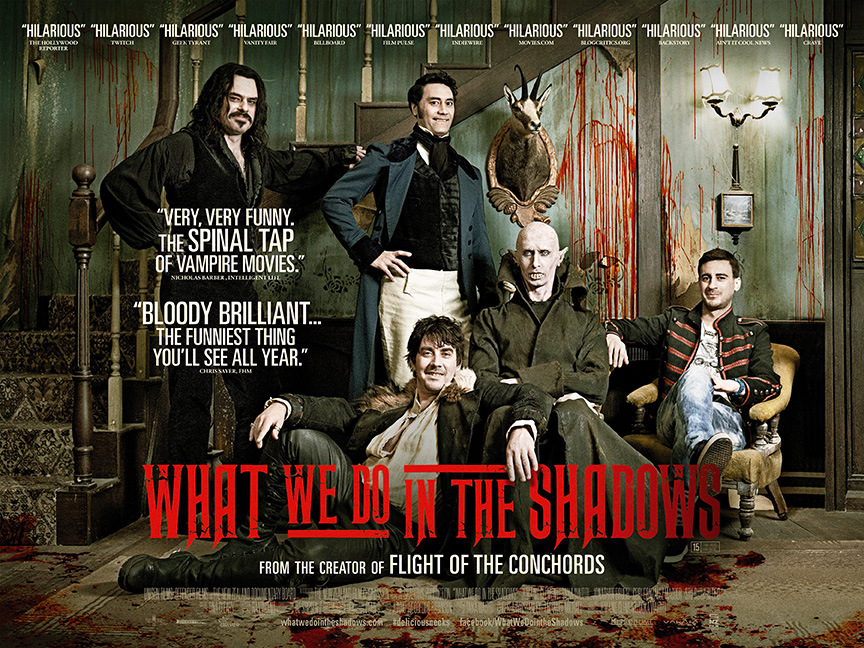
Movies: What We Do in the Shadows

Are you sick of books, movies, and TV shows about vampires? Of course you are! The vampire fad died a slow, agonizing death with each passing season of the once pleasurable and eventually awful True Blood. But before you throw the hat in completely, let me recommend one more bloodsucking film for the road: What We Do in the Shadows.


This film, directed by Taika Waititi and Jermaine Clement (two of the creators of Flight of the Conchords), is a work of comedic genius. Filmed in documentary style, it follows the daily events of four vampires who live as flatmates in modern New Zealand. There's Viago (played by Waititi), a chipper 300-something year old vamp who serves as the "cruise director" of the documentary, showing the filmmakers around the flat. There's Deacon (Jonny Brugh), who is the youngest of the group at age 180 and is very into flamboyant club wear and sex. Vladislav (Clement) is a bit more mature at 560-ish, but also tends towards fits of depression that lead him to capture people and torture them. In his human life he was known as "Vladislav the Poker" for his love of poking people with hot irons and the like. When he is introduced to Facebook and someone tells him he can "poke" a friend, his look into the camera is priceless.

Finally, there's Petyr (Ben Fransham), who is 4,000 years old and looks like this:


Needless to say, Petyr doesn't get out as much as the others.

WWDitS shows Viago, Deacon, and Vladislav going about their daily lives: they have a chore wheel to make sure everyone cleans up after themselves; Viago talks about his techniques in wooing a lady before killing her and drinking her blood; and the guys get into a few scuffles with a local gang of werewolves (pack leader Anton is played by Rhys Darby, better known as Murray from Flight of the Conchords). When the guys accidentally turn intended victim Nick (Cori Gonzalez-Macuer) into a vampire life gets more complicated as they now have to look after a baby vamp (although the upside is they get to hang out with Nick's friend Stu, who they all like more than Nick)

It's no surprise that WWDitS shares a similar sense of humor with Flight of the Conchords. The humor is deadpan and absurd, exposing the inherent silliness of vampire tropes, such as avoiding the sun's deadly rays and being able to fly. I don't want to say too much about the movie or give away any of the best jokes. So I'll leave you with this: if you hate the vampire trend in pop culture, you will love What We Do in the Shadows...and if you *love* the vampire trend in pop culture, you will also love What We Do in the Shadows. Basically, it's a win-win.

Grade: A 

Monday, June 8, 2015

Fears for Ears

Movies: Berberian Sound Studio

Peter Strickland is quickly becoming one of my favorite directors. I reviewed his luscious 2014 film The Duke of Burgundy not too long ago and when I saw that his 2009 film, Berberian Sound Studio, was on Netflix...well, I had to watch it immediately.

I was not disappointed. Berberian Sound Studio is a creepy little movie starring Toby Jones as Gilderoy, a nebbishy British sound engineer who is hired to oversee the sound production on an Italian horror film titled "Equestrian Vortex". We do not see any of this movie-within-a-movie, but we hear it described. "Equestrian Vortex" is a giallo film--a genre of Italian mystery-horror that reached its peak in the 1970's (the time period in which Berberian Sound Studio takes place). Giallo films are known for their lurid, violent imagery and plot lines. "Giallo" itself means yellow--a reference to cheap paperbacks with yellow covers that were popular in post-WWII Italy.

So "Equestrian Vortex", the film we don't see but do hear in Berberian Sound Studio, is about two girls at a horse-riding academy who accidentally resurrect some dead witches. The witches are still pretty pissed about being tortured to death during the Inquisition, so they proceed to take revenge upon the ladies of the equestrian academy. The plot is filled with rotting corpses, agonizing torture, and "dangerously aroused" goblins stalking the nubile girls. In other words, extremely violent and sleazy. Gilderoy, a mild-mannered confirmed bachelor, is not used to working on such violent films and becomes increasingly upset. It doesn't help that the producer of the film, Francesco (Cosimo Fusco), and the other crew members are rude to him and dismissive of his considerable gifts as a sound engineer. Meanwhile, the director, Giancarlo Santini (Antonio Mancino), is too busy molesting the actresses to take much notice of Gilderoy.


Gilderoy begins to crack up. He is required to do foley work that involves ripping out the stalks of radishes to create the noise of a priest ripping out a witch's hair during an interrogation and drizzling water into a hot pan to mimic the sound a red hot poker going into a place a red hot poker should really, really not go. Toby Jones, such a wonderful actor, sells Gilderoy's break with reality so well. At first, he to stand up for himself. When that fails, he withdraws into himself, barely paying attention to his work. Finally, when an actress comes in to read for the part of one of the equestrian girls and fails to scream "realistically" enough, Gilderoy reacts with sadism, forcing her to listen to screeching sounds through her headphones until she quits.

Like Duke of Burgundy, Berberian Sound Studio is different and strange. It doesn't have much of a plot, but it is a feast for the senses--in this case, mostly the ears. Like Duke of Burgundy, it feels somewhat removed from reality, as if it inhabits a world similar to ours but with different rules and expectations. I found it intriguing and disorienting. I do wish it had a stronger storyline and resolution. Ultimately, I was left a little bit hungry--wanting more out of the film.

Even with its shortcomings, Berberian Sound Studio is really solid, really interesting work. Like Duke of Burgundy, the experience of watching it is closer to visiting an art museum (or, in this case, a soundstage) than seeing a movie. I'm very excited to see what tricks Peter Strickland will pull out of his hat in his next film.

Grade: B+