Monday, January 22, 2018

On Pincushions and Needles

Movies: Phantom Thread

Well, this movie certainly was....something. Paul Thomas Anderson's latest and Daniel Day-Lewis's (supposedly) last-est film is beautiful to the eyes and ears, but (as per usual with PTA) an uncomfortable and cold ride to a truly surprising end.

Set in  1950s London, Phantom Thread follows one Reynolds Woodcock (Day-Lewis), a highly regarded designer of women's dresses who is called upon by stars and royalty to fashion them beautiful (and often extremely constraining) dresses for balls, weddings, Christenings, etc.

Woodcock lives and works in a posh, multistory town home in London with his sister and secretary/business partner Cyril (Lesley Manville). Both Cyril and Reynolds are middle-aged and unmarried, focusing solely on Reynold's work as the anchor point for both of their lives. However, Reynolds has the occasional girlfriend he uses and then discards when he gets bored or annoyed by her. He feels cursed to never marry, although that curse is more of a self-fulfilling prophecy given his extreme arrogance, fussiness, and nearly sociopathic emotional distance.

The Woodock siblings also have a home in the countryside which they visit often, and on one of his trips out there, Reynolds finds himself captivated by a young, fresh-faced waitress, Alma (Vicky Krieps). He immediately asks her to have dinner with him and on their first date he takes her home...to take her measurements. It seems that Reynolds has not only found a new girlfriend, but a muse, model, and employee all in one. The way he dispassionately measures Alma's body, remarking "you have no breasts" in an even tone, shows that his interest in her is more aesthetic than sexual. She, like everything else, exists only to inspire and further his work.


But once Alma moves into the Woodcock home, she and Reynolds begin a bizarre courtship dance. Her habits (such as buttering her toast too loudly at breakfast) annoy him and he makes that clear to her...but instead of backing down, she ignores his annoyance and just does her thing. She pokes through his fussy ice princess personality, making him laugh and rage in equal measure. She takes note of the times after he has completed a huge project and becomes emotionally drained for a few days, remarking to a friend that he is "tender and open"--even willing to snuggle (!!??!!) with her--during these periods.

I read a review of this film that called it "kinky". Considering that I planned to see it with my parents, I was a little nervous. Would there be spanking? Choking? Bondage? Nope. The Phantom Thread has so little sex, an adjective to describe it could be "asexual". But it is, in fact, "kinky" nonetheless. The psychological warfare between Alma and Reynolds is the essence of a Dom/sub relationship...and while in most cases he is the clear Dominant, Alma finds a sneaky way to get him to fully submit and surrender to her--no fur-lined handcuffs needed.

The three leads excellent. Daniel Day-Lewis. This fucking guy. Has he ever done a poor acting job? He's willing to go into the dark depths of the soul for absolutely despicable characters (see his previous collaboration with Paul Thomas Anderson in the brutal There Will Be Blood). While Reynolds is hardly a monster, he is an absolute pain in the ass--he's pedantic, he hates fun, he's a workaholic--and Day-Lewis goes "vanity free" as they say in bringing this asshole to life.

Vicky Krieps is a prolific European actress and virtual unknown in the United States. She plays Alma as an observant, quiet, yet very strong-willed woman. I had trouble understanding what she saw in Reynolds, but perhaps she liked the idea of poking through the defenses of such an emotionally removed man. Alma knows that she has power over Reynolds that no other woman--including Cyril--has. And that intrigues her and gives her life meaning. And that's kind of sexist, but, you know...it's the 1950s. What ya gonna do?

And Lesley Manville is wonderful as Cyril, the steady rock to Reynold's tempest-like personality. They are bound together in an overly close brother-sister bond and when Alma starts messing with that dynamic, Cyril is not happy. 

The cinematography is not just beautiful, it's fetishistic in its focus on fabric, needles, haute coture, and female faces and bodies. And the musical score (by Radiohead's Jonny Greenwood, a frequent collaborator of Anderson's) is sweeping and epic, but also creepy and intimate.

Phantom Thread is a gorgeous, meticulously crafted film. It's also very slow with, to be honest, not much reward. I mentioning the surprising ending, but it's not exactly a shocking twist. It's more of a realization that makes you guy "Huh. Ok then."

Phantom Thread is an objet d'art that feels as cool, clean, and composed as a museum. It's a very good movie and one I probably won't watch again.

Grade: B+


Sunday, January 21, 2018

Let's Hear It For the Boys

Movies, TV: Call Me By Your Name; Looking

I watched HBO's excellent (and gone too soon) series Looking last fall but I've been holding back on reviewing it because I wanted to pair it with a specific film: Luca Guadagnino's transcendent Call Me By Your Name.

Both the series and the film are about gay men. Although in Call Me By Your Name, homosexuality is more about a moment, a summer, a person and less about identity in the way it is in Looking.

I have a special place in my heart for gay men, which might be a weird and even offensive thing to say. But I was friends with a lot of gay guys in high school and gay male love and sexuality was a simultaneously safe and excitingly forbidden lens through which to explore, think about, and consider my own sexuality at a time when I wasn't ready to explore that part of me with actual real live dudes.

There's also something inherently political about queer love and sex that gives it something extra. Being openly queer, even today (especially today), is a risk. Being openly queer and openly in love is an act of courage and faith. And I don't mean to fetishize or pedestalize queer relationships because I think you could argue that to fall in love no matter what your identity is to be courageous. The essence of love is vulnerability, after all. But with queer people, the stakes are undoubtedly higher.

Consider what AV Club's Brandon Nowalk writes in his review of "Looking for the Future": "Whatever your experience with gay pop culture, there is activism in this story of two guys falling for each other, and it works by simply selling the reality."

And both Looking and Call Me By Your Name so perfectly capture reality. And it will break your heart.

Call Me By Your Name is, above all, gorgeous. Set in northern Italy in 1983, the film is about Elio, the 17-year-old son of a professor of archaeology (Michael Stuhlbarg, playing a truly warm and loving father) who invites a graduate student to live with the family every summer and help with academic work. This summer, the lucky student is Oliver, a 24-year-old American with movie star looks and confidence and charm for days. 

Elio is played by Timothee Chamalet, an up-and-coming young actor (who was also in Lady Bird this year) who is just SO GOOD in this role I want to explode. He plays 17 SO WELL (probably because he's only a few years past that tumultuous age). He captures what it's like to be a teen who is too smart for his own good--he's all limbs, constantly moving, pretending to be cool when really he's a mess of emotions. Give this kid an Oscar.

As for Armie Hammer...well, at first I thought he was miscast. Hammer is 31 years old and playing 24. He *looks* 31, and this is a bit of a problem considering that the age difference between the two leads borders on not okay (for what it's worth, the age of consent in Italy is 14...which is kind of fucked up, but that's another story). There's been a fuckton of ink spilled on whether or not CMBYN is a story of predation, but from what I saw, it wasn't. Consent is fully established between the characters, though given Chamalet's teenage looks and behaviors compared to Hammer's adult looks and behaviors, I did wonder if they could have cast a younger-looking actor to play Oliver. But maybe choosing a mature-looking and acting man to play Oliver was a deliberate choice?

As the film entered it's second half, I have to say that I came to appreciate Hammer's presence as an impossibly tall, impossibly handsome man who falls for the teenage Elio. The first half of the movie focuses a lot of Elio and his awkwardness around Oliver, but the second half takes the time to zero in on Oliver's mixed feelings about their sexual tension and eventual affair. Oliver, like Elio, has the capacity for heartbreak. 

CMBYN draws out the "will they or won't they" tension for a long time and in a manner that feels realistic. Not only is Oliver older than Elio, he also kinda sorta works for Elio's dad. After the two share a kiss, Oliver holds back on going further, saying "We've been good. We haven't done anything to be ashamed of. I want to be good".

But, oh, does Oliver really want to be bad.

There's a lot of sex in CMBYN. It's not explicit--mostly kissing and tussling, as well as a memorable scene involving a peach--but if you're uncomfortable with men kissing men, you will not enjoy this movie. I was kind of glad no one was sitting next to me in the theatre, since watching this film felt like an incredibly intimate experience. But what I truly appreciated was how honest the portrayal of desire was, especially Elio's late-teenage horniness and longing. Nothing about it felt cliche or phony. And Michael Stuhlbarg gets a gut-wrenching monologue in the film where he encourages Elio (and the viewer) to accept and even embrace heartbreak as part of life--and consider yourself lucky for having felt it.


I left Call Me By Your Name with the feeling that there was something very special about it. In addition to the beautiful scenery, the on-point acting, and (not gonna lie) the blush-worthy sex...it just felt honest, and forgiving, and open-hearted more than anything else. It's a film about first love and I think we all understand that someone's first love is a treasure. We love with our entire hearts when we're young because we haven't yet learned to hold back and protect ourselves. I hope you'll see Call Me By Your Name because it's rare movie that is both brimming in heart and soul (and, ahem, body).

Grade: A+

***

Looking is most definitely NOT set in northern Italy in 1983. It's set in San Francisco in the 20-teens. It's the gay men's answer to Girls (only its wayyyyy fucking better than Girls). It's also not about first love. It's about men in their 30s and 40s who are opening their own businesses and moving in with partners, and--oh yeah, maybe also fucking their bosses? (spoiler alert?). These guys are way past the innocence of first love and loss of virginity. And yet, that same sense of open-heartedness and willingness to screw up and be vulnerable infuses the characters' personalities in a way you don't often see in television shows....especially when they're about ironic millennials who live life with a smirk. 

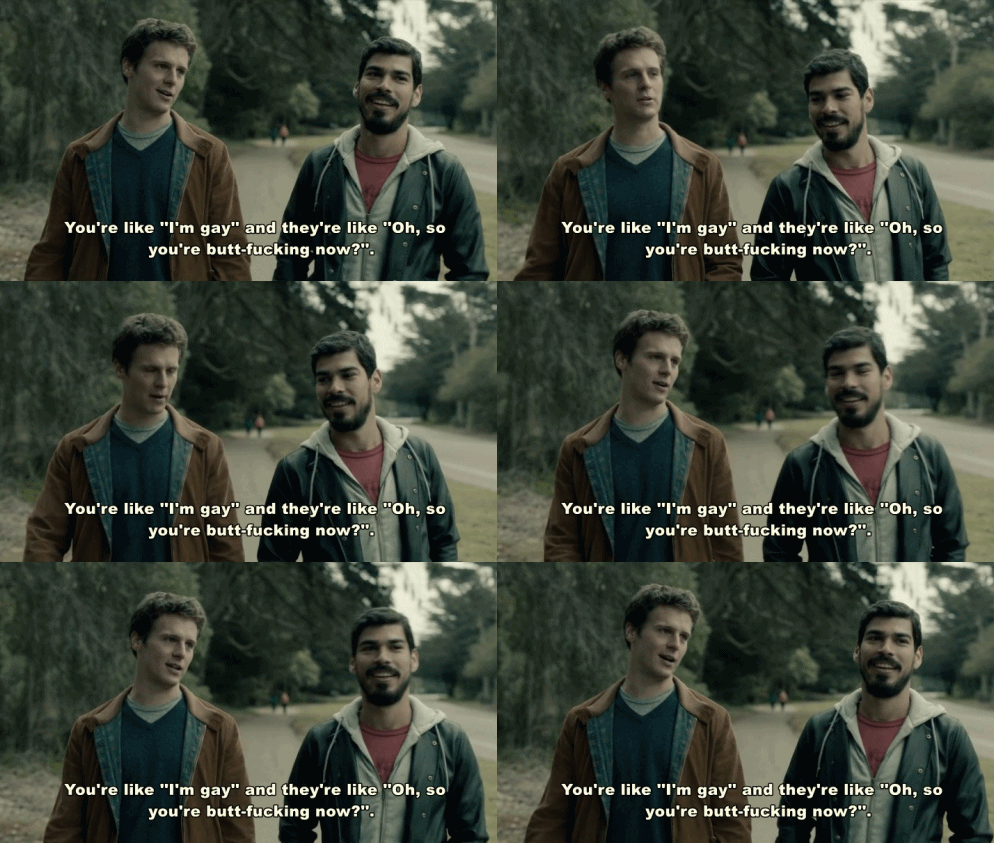
Looking follows three friends: wide-eyed, optimistic video game designer Patrick (Jonathan Groff), temperamental artist Agustin (Frankie J. Alvarez), and 40-something (but still super hot) waiter-slash-trying to open his own restaurant Dom (Murray Bartlett). There's also Doris (Lauren Weedman), Dom's best friend and signature "faghag" of the group, although she elevates the demeaning stock character of "faghag" to something much more human and relatable (and she gets her own love story too).

Looking had two short seasons before it was brutally cut to make room for other bullshit on HBO (*coughGirlscough*) and then given a movie to wrap things up. I'm amazed at how much was accomplished in those seasons and final film but I'm also sad to think of how much more the characters could have been fleshed out if given more time.


Although all the characters get plenty of screen time, the main focus is on Patrick, which was a bit of a problem considering Patrick is a cisgender white male in a series that otherwise does a pretty good job of highlighting queer men of color. But I have to admit, I liked Patrick a lot--he was just such a good-hearted goofball in a way you don't see a lot on TV, especially in HBO shows. Cynicism is in style, and I appreciated Patrick's complete and utter lack of cynicism. It was a breath of fresh air.

Much of the series follows Patrick's two big romances: the first with Richie (Raul Castillo), a down-to-earth (and stupidly hot) barber. The second is with Kevin (Russell Tovey), Patrick's new boss who is British, has huge ears, and is in a relationship....but open to a little strange on the side. To me, the person whom Patrick should end up with is clear, but of course the show needs to put him through the ringer before he realizes which man was truly there for him all along. 

A criticism lobbed at Looking was that it was boring. Which is weird because I binged all of it in like 3 days and cried for more. I liked that it wasn't as pretentious as Girls (I'm giving Girls, a show I was an apologist for, quite a bit of shit here, aren't I?) or as fast moving and dramatic as many shows are in our binge-watching culture. I enjoyed that fact that Looking focused on the minutiae of daily life: birthday parties, Halloween parties, drugs-and-sex-in-the-woods parties (gay men in San Francisco like parties, apparently). The plot arcs the characters follow--Patrick's love triangle, Agustin's relationship with an HIV positive man (Eddie, the best fucking character on the show), and Dom's new restaurant--are significant but also "mundane" in the sense that they are issues that everyone faces. Love problems, health problems, money problems. But seen through the specific lens of time, place, and identity. And, of course, friendship is at the heart of it all.

In a year where I watched so many wonderful TV shows (hi there, Twin Peaks: The Return, Crazy Ex-Girlfriend, and The Handmaid's Tale), there was no show that offered me such a sense of delight as Looking did. While many of the shows I watched this year had themes that ranged from important to heavy to downright brutal, Looking was an escape hatch that wasn't too light. It's anchored in reality, but looking (heh) upwards and into the future with a sense of hope and purpose. It really was gone too soon. I guess some shows are too good for this world.

Grade: A+


Saturday, December 30, 2017

Lover From the Black Lagoon

Movies: The Shape of Water

Guillermo del Toro's The Shape of Water is clearly inspired by 1954's Creature from the Black Lagoon. del Toro, a director known for making films that walk the line between the real and the fantastic, also appears to borrow from the work of Jean-Pierre Jeunet. Jeunet's films--in particular The City of Lost Children and Delicatessen--are both whimsical and a little scary and bizarre. They're like the original Grimm's fairytales, filled with evil men and strange creatures, violence and playfulness.

Despite pulling from the work of other directors, classic horror and science-fiction, and millennia of fables and fairytales, The Shape of Water is anything but derivative. del Toro has done something remarkable with this film: he's taken half a dozen different genres--suspense, romance, drama, fantasy, history, and horror (with a sprinkling of comedy)--and stitched them together in such a way where no one genre dominates another. And at the heart of this tale is a desire common to all humans (and, apparently, non-humans as well): the longing for connection and the desire to be seen and accepted as we are.

del Toro also accomplishes a difficult feat: he makes us believe that a woman might actually want to fuck an amphibious half-man, half-creature. And fuck they do. Hoo boy.


Taking place in 1960, The Shape of Water follows Elisa Esposito (in a career-best performance by Sally Hawkins), a mute cleaning woman who works the graveyard shift at a government research facility in Baltimore. Elisa's only friends are her closeted gay neighbor, Giles (Richard Jenkins), and fellow cleaning lady Zelda (Octavia Spencer). Elisa seems to lead a quiet, orderly, and lonely life.

Then one day, the research facility becomes home to an "asset"--a sea creature that was captured and brought to Baltimore by Colonel Richard Strickland (Michael Shannon, malevolent and somewhat sexy as he always is). Strickland and his superior, General Hoyt, see this creature as a potential weapon in the Cold War and want to vivisect it to see how it works. Scientist Bob Hoffstetler (Michael Stuhlberg) sees the creature as "beautiful" and wants to treat it with gentleness and certainly not kill it. Meanwhile, Elisa sneaks into the lab where the creature is kept chained up and feeds it hardboiled eggs and teaches it sign language. She discovers that the creature can communicate and feel emotions. When she overhears the plans to vivisect her new friend, she decides to bust the creature out of the facility and set it free.

There's also a Russian double-agent subplot as well as a subplot involving Giles in his attempts to express his desire for other men. del Toro manages to make these plot lines vital to the story and its themes of what it means to be an outsider and to be misunderstood. In fact, every character in The Shape of Water is misunderstood in some way, and forced into submission by other people, by society, or by circumstances. Of course, Elisa is misunderstood in a literal sense by being mute. Giles is a gay man in the 1960s, Zelda is a black woman, and the creature is, well, not human. But even Richard Strickland--the "bad guy" of the film--is misunderstood and bullied by his superiors. He reacts by acting aggressively towards those weaker than himself, but his pain is understandable even if his actions are deplorable. Like most great films, The Shape of Water has no one-dimensional characters and no simple answers.

Director of Photography Dan Lauston films The Shape of Water with a wonderful palette of shades of green, from the bright green candy that Strickland compulsively consumes to the grayish-blue green of the water where the creature lives. Green is a symbol of renewal and nature. Likewise, eggs show up in the movie a lot: Elisa hard boils them everyday before she heads to work, and her first connection with the creature is when she offers it an egg to eat. Like the color green, eggs are also symbols of rebirth and fertility, and The Shape of Water--especially the ending--is the story of Elisa's rebirth in the face of finding a connection and love where she leasts expects it.

If you think that a movie about a human woman falling in love with a non-human creature is silly or stupid, of course I only have to point to King Kong, or Beauty and the Beast, or every vampire and werewolf story ever told. Stories like these are about being loved for who we are, no matter our outside packaging. Stories about monsters are also about being hated or feared by society and a demand for conformity.

The Shape of Water takes place during a precarious time in United States history. The early 1960s was a time of manners and hierarchies, but it was also right before the world blew wide open with JFK's assassination, the Civil Rights Act, and Woodstock. The Shape of Water reveals that during this time in the United States, beautiful strangeness--or maybe a more accurate term would be "queerness"--existed right there under everyone's nose. That queerness, like the creature in the movie, lurked below the surface, just waiting for its moment to emerge from the depths and demand to be seen in all its glory.

Grade: B+

Thursday, December 28, 2017

A Portrait of Grief 14 Feet High

Movies: Three Billboards Outside Ebbing, Missouri

It's difficult to pin down exactly how I feel about Martin McDonaugh's Three Billboards Outside Ebbing, Missouri. Like his 2008 film In Bruges, it's a mix of intense drama and pitch-black comedy sprinkled with a light dusting of absurdity. The concoction, not unlike when I first had a salted caramel flavored beer, is both strange and addictive: I'm not sure what I feel about this, but I....I kinda like it!

Three Billboards is the story of a mother's grief. Frances McDormand, who is excellent in every movie she's been in, including this one, plays Mildred Hayes, a middle-aged woman whose daughter was raped, killed, and burned into unrecognizable ash just outside the town limits of Ebbing. After 7 months, it seems like the local police force is too busy sitting on their thumbs to make any arrests. So Mildred rents out three dilapidated billboards along the road where her daughter was murdered to send a message to the police and specifically the chief. The messages read:

RAPED WHILE DYING

AND STILL NO ARRESTS?

HOW COME, CHIEF WILLOUGHBY? 


(To give you a sense of the kind of humor this movie trades in, when Mildred and her 17 year old son, Robbie [played by the wonderful Lucas Hedges], drive down this road, Robbie remarks "Oh, great, the 'Raped while dying' route")

Chief Willoughby is played--also wonderfully (every single actor in this film brings their A-game)--by Woody Harrelson. Willoughby is a good man and beloved by the people of Ebbing, so Mildred gets tons of shit by putting up these billboards. Even the town priest pays her a visit to implore her to take them down. But Mildred rightly points out that she's gotten more phone calls, house calls, and attention in the days following the erection of the billboards than in the 7 months following her daughter's brutal murder.

Willoughby treats Mildred with respect compared to other members of the community, including her ex-husband Charlie (played--you guessed it--wonderfully by John Hawkes) and the hotheaded, slow-witted police officer Dixon, played MORE THAN WONDERFULLY by Sam Rockwell in one of the best performances of his career--which has been filled with amazing performances.

Officer Dixon is probably the most complicated character in the film. He's angry and abusive, but he longs for approval. He's the epitome of a blatantly racist small-town cop. He's everything wrong with police today distilled into one character: not that smart, thinks he's all that, lazy as hell--except when beating the shit out of innocent people. He's irredeemable. Or so you think....Three Billboards is full of surprises, both good and bad.

I won't get into the details of the plot since that would spoil the movie, but I'll distill my overall impressions into a couple sentences and you can decide if this is a movie you want to see:

1) As I said, the acting in Three Billboards is, to a performance, excellent, A+, perfecto. You will not be disappointed by a single performance in this film. Somehow, McDonagh gathered Hollywood's best and brightest and wrung out every drop of acting they had to give.

2) If you like movies where justice is served and peace and order restored in a way we rarely see in real life, then this is not the movie for you. The plot arc is really more of a rollercoaster and there's no neat little bow tying things up and the end.

3) There is, however, redemption. Three Billboards might be the most "Christian" movie that's not explicitly about religion I've seen this year. In particular, the character arcs that Mildred and Dixon travel throughout the film are like something out of the Bible (or a Greek tragedy, as my mother, who saw the movie with me, said). Three Billboards is about a lot of things, but it's surprisingly not about justice. It's about something deeper than justice--it's about forgiveness, redemption, hope, and love. And if all that sounds cheesy, I can assure you that the path this film takes towards these fuzzy feelings is the opposite of cheesy. It's goddamn brutal. It's a trial by fire, literally. To steal the title of a Rebecca Solnit book, it's about "Hope in the dark".


Three Billboards Outside Ebbing, Missouri will enrage you. It will make you laugh. It will make you cry. You might hate it or you might love it. But I can promise you one thing: It won't bore you.

Grade: A-

Tuesday, December 12, 2017

Oh Hai Movie

Movies: The Disaster Artist

"Visions are worth fighting for. Why spend your life making someone else's dreams?"

The above is a quote from the wonderful Tim Burton film Ed Wood in which famed terrible director Ed Wood (Johnny Depp, before he was the caricature he is today) meets with Orson Welles (played by Vincent D'Onofrio). Wood is about to give up his directing dreams when Welles tells him to believe in himself. The joke is, of course, that Wood is essentially the polar opposite of Welles in terms of talent. But the quote has always stuck with me as a pure-hearted bon mot in a cynical world. Even if you're a no-talent hack, you still have a right to your dreams.

In order to appreciate James Franco's film The Disaster Artist, you first need to know what The Room is. Here is the Wikipedia entry for it and here are some options for where to watch The Room, or at least clips of it.

But to give you the elevator pitch, The Room is a 2003 film written, directed, produced, and starring a man name Tommy Wiseau. The Room has achieved cult status for how absolutely awful it is on every count: the actors are wooden, the script is terrible, and the plot is thin. But the cult behind the room would be nothing without the mystery of Wiseau--a man with a seemingly bottomless bank account, a bizarre accent, and dreams that stretch far beyond his talent.

Unlike Ed Wood, who was an all-American man (who, incidentally, enjoyed wearing women's clothing) with optimism and goofy charm, Wiseau is pretty much an asshole by all accounts. He bullied nearly everyone on the set of The Room, refusing to buy water for the cast and crew even at the peak of summer and calling the moles on his lead actress's body "disgusting". These revelations came to light in a memoir co-written by Greg Sestero, Wiseau's friend and second lead actor in The Room. That memoir is titled The Disaster Artist and it is the basis for this film, directed and starring James Franco. A rather strange actor/director/writer/producer in his own right, Franco is pretty much the perfect auteur to take on this project.

Franco plays Wiseau to near perfection, nailing the vaguely Eastern European accent and strange mannerisms impeccably. Franco's younger brother, Dave, plays Greg Sestero, which is arguably a more difficult role since it's far more subtle than mimicking Wiseau.

The Disaster Artist opens in 1998 San Francisco where Wiseau and Sestero meet in an acting class. Where Sestero is conventionally good-looking but timid onstage, Wiseau looks, acts, and dresses bizarrely but is absolutely fearless in the class. Well, that or crazy. But we all know that there is a thin line between madness and genius.

Sestero and Wiseau become friends and eventually Wiseau convinces Sestero to move with him to Los Angeles and make a real effort to pursue acting. Sestero agrees and they move to an apartment Wiseau already owns. The fact that this man owns apartments in both San Francisco and LA is mind-boggling to Sestero--how does he have all this money? To make matters more mysterious, Wiseau claims to be from Louisiana although he clearly has an Eastern European accent. And he refuses to tell Sestero how old he is. When pushed, he claims to be Sestero's age: early 20s. The man is OBVIOUSLY at least two decades older, but won't cop to it. What's up with this guy?

After multiple rejections, Wiseau decides to make his own movie and give himself the starring role and Sestero the second lead. The movie, titled The Room, is about Johnny, an "all-American hero" in Wiseau's words, who is betrayed by his girlfriend who sleeps with his best friend, Mark (played by Sestero). Through sheer force of will and with a little help from the apparently millions of dollars Wiseau inexplicably has in his bank account, he gets the film made and released.

Franco cast dozens of actors and comedians for The Disaster Artist. No role is too small. Ari Graynor plays Juliette Danielle, who plays "Lisa" in The Room, the unfortunate young woman who had to endure a sex scene with Tommy Wiseau. Seth Rogen plays Sandy Schklair, the script supervisor. Additionally, for you Room-heads:

Josh Hutcherson plays Philip Haldiman, aka "Denny"
Nathan Fielder plays Kyle Vogt, aka "Peter"
Jackie Weaver plays Carolyn Minnott, aka "Claudette" (the one who "definitely has breast cancer")
Zac Efron plays Dan Janjigian, aka "Chris-R"

Oh, and all three hosts of the podcast How Did This Get Made?--Paul Scheer, June Diane Raphael, and Jason Mantzoukas are in the movie.

Oh, and why not throw Sharon Stone, Melanie Griffith, Hannibal Buress, Allison Brie, Bryan Cranston, Megan Mullally, Charlene Yi, and fuckin' Bob Odenkirk in there as well? Seriously, all of Hollywood got a paycheck from this movie. Hell, I visited LA for a couple days this year, so I expect my royalties check to come in the mail any day now.

Seeing huge stars in tiny roles playing terrible actors working with a terrible script is part of the fun of The Disaster Artist. The film is less of a compelling and accurate tribute to Wiseau (they definitely downplayed his weirdness and on-set abuse, most likely to have his permission to the rights to his story) and more of a meta-comedy about fame and movie-making. Some folks have suggested that The Disaster Artist is "Oscar worthy" and I personally do not agree. It's a funny, good movie that speaks almost exclusively to fans of The Room (I can't imagine what people who have not seen The Room and walk into this movie blind will make of it) but it's not a masterpiece. In my opinion.

Even though it falls back on buddy-comedy tropes (Sestero and Wiseau have a massive falling out, but make up in the end), The Disaster Artist is great fun and pretty darn hilarious. I definitely recommend it to fans of The Room. For people who haven't seen The Room, I actually *do not* recommend seeing The Disaster Artist...yet.

First: Watch The Room "dry" just to familiarize yourself with the movie and how uniquely awful it is.

Then: See The Room during a midnight screening that includes audience participation. This is The Room in its truest and ideal habitat.

Bonus:  Read The Disaster Artist by Greg Sestero and Tom Bissell to understand the full story and insider's perspective behind the making of The Room

And then you're allowed to watch The Disaster Artist. If you see The Disaster Artist without fully appreciating the story behind it, you might find yourself saying

Grade: B+


Monday, December 11, 2017

No-Tell Motel

Movies: The Florida Project, Voyeur

Two movies that revolve around cheap motels, one very good and one....problematic, to say the least.

The Florida Project

Directed by Sean Baker, whose 2015 film Tangerine made waves on the indie circuit, The Florida Project is a small movie with a big and complicated heart. The film focuses on 6-year-old Moonee, a sassy scamp of a girl who lives in a motel with her mother, Halley, and spends her days causing mischief with her friends Jancey and Scooty. While the film is ostensibly about the innocence of childhood, Baker almost immediately pulls back the curtain to reveal how fucked up and precarious Moonee's world actually is. Her mom is little more than a child herself--probably in her early 20s, no job, incredibly bad attitude toward those who only try to help her. In short, she's a terrible mother. While not abusive, per se, Halley's choices impact Moonee's life in ways neither Moonee nor Halley fully comprehend. If The Florida Project isn't excellent marketing for birth control and the morning-after pill, I don't know what is.

The motel where they live is owned by Bobby, who is played with deep wells of compassion by Willem Dafoe, the biggest star of the movie. Technically, Halley and the other women (all with small children) who live there are not legally allowed to take up permanent residence, but Bobby makes exceptions for them all despite the fact that Halley yells at him and causes him all sorts of trouble. Bobby acts as a de facto father figure to Moonee, Scooty, and Jancey who spend their days running around unsupervised (the film takes place over the summer, so they're not in school). I don't even have kids, yet I was cringing to see these little ones running along busy streets and exploring abandoned houses filled with debris.


But Baker didn't make this movie to shit on Halley and the other residents living hand-to-mouth. He shows a side of poverty most people (especially people who go see artsy movies like The Florida Project) never get to see. Social conservatives will shit themselves from scene one, in which children have a bit of fun spitting on parked cars and calling the adult woman who chastises them a "bitch". Is there something that's the opposite of a wet dream? Because this movie is whatever that is to conservatives who are anti-welfare, anti-sex work, and anti-single mothers. It hits on nearly every stereotype of the poor that conservatives believe: that they're entitled, lazy, and immoral. BUT, by showing this hard knock life through the eyes of children, Baker humanizes both the children and the adults and shows how difficult it is to break the cycle of poverty. He also shows how even a "bad mother" can have her moments of deep love and caring: when Halley takes Moonee and Jancey to see fireworks for Jancey's birthday and presents her with a Little Debbie's cupcake with a candle stuck into it to serve as a birthday cake. Ill-equipped moms have hearts too.

The Florida Project's saving grace is its humor and its honesty. The movie is actually hilarious, mostly due to Moonee and her friends' antics. And when I say it's an honest, I mean that Baker doesn't pull any punches: he does not romanticize poverty nor does he portray poverty as a living hell. He doesn't put the poor on a pedestal. There are no noble Bob Cratchits in this movie.

At the end of the day, The Florida Project is just a slice of life...a kind of life that many, many people live filled with struggles, hustling, and trying to take your pleasure where you can find it. Baker honors that and asks us not to close our eyes and shut our ears to the stories of people who live a harder life than we live.

Grade: A-

***

Voyeur

Released on Netflix, Voyeur is a documentary about a man, one Gerald Foos, who bought a Colorado motel with the sole purpose of spying on people who stayed there. He created little vents in the ceiling of each of the rooms so that he could spy, unseen and unheard by the residents as they watched TV, argued, and had sex. Foos did this for years without ever being caught until he sold the motel.

This documentary shows Foos' relationship with iconic journalist Gay Talese, who wrote a story about Foos titled "The Voyeur's Motel" for The New Yorker in 2016 and recently released a book about the story of the man who peeped on people for years.

Supposedly, the twist is that Foos claims to have witnessed a murder in the motel--a murder that he inadvertently played a role in. He spied a drug dealer hide his stash in a vent in one of the rooms and then he--Foos--went in and took the drugs. Later, he watched through the vent in the ceiling as the dealer discovered the drugs were missing, blamed his girlfriend, and then strangled her. Foos didn't stop him or call the police. By all accounts, we should be able to add "accessory to murder" on top of Foos' peeping Tom charges...

Only Foos has never been charged or faced any consequences for his actions. To me, this is the real twist of the story and the one that makes me wonder if the filmmakers were ethically wrong to make this film and Netflix ethically wrong to release it.


While Voyeur certainly doesn't celebrate Foos, it doesn't really do enough to make it clear that what he did was SUPER WRONG. I mean, the guy built a literal "observation platform" to watch people fucking in his own goddamned motel! He supposedly claims he saw a murder (the documentary suggests that Foos made this story up) and didn't do anything to help. He betrayed the implicit trust in the patrons of his motel.

Yet Voyeur is honestly more interested in Gay Talese than anything else. While the film is about Foos, it spends a lot of time explaining who Talese is and his relationship with Foos that dates back to the 80s, when Foos wrote a letter to Talese explaining to him that he had bought a motel for the express purpose of voyeurism and that he kept a log of everything he observed. Then, Talese came out to visit Foos at the motel and Foos took Talese up the observation platform and they spied on a couple having sex. Yes, not only did Talese know Foos was actively committing something that, if not illegal, was highly unethical, he participated!!

You guys, I'm no saint. If I lived in a high-rise apartment building in a big city you better believe I'd have a pair of binoculars by the window. Voyeurism is fascinating and I think all of us have curiosity about what people do and say behind closed doors. But buying a motel and remodeling it so that you can spy on your customers every night for decades is wrong. The people being spied on did not consent to it--and that's exactly what Foos liked about it--that they couldn't see him, but he could see them. And Voyeur is not a clever enough, ethical enough, or ambitious enough film to both tell Foos' story and make it crystal clear that the man is a fucking criminal.

If I sound a little hesitant to fully condemn it, I guess I am because I don't know all the details about the legality of peeping (I think the fact that the statue of limitations was up allowed Foos to not be charged for crimes he committed years before). But Voyeur left a bad taste in my mouth and I really think it should not have been filmed or released--it's giving a man who took advantage of others a chance to speak for himself when all those people whose privacy he invaded don't have the opportunity to tell *their* story or get justice. I can't recommend the movie at all, and therefore I'm not going to give it a grade.

Grade: n/a 

Sunday, December 3, 2017

Lady Be Good

Movies: Lady Bird

Directed by Greta Gerwig, Lady Bird takes inspiration from the best coming-of-age films, such as Rushmore, Election, Donnie Darko, and Ghost World and improves on them by defying cliches, being truthful to the female teenage experience, and--a rarity in the teen movie Canon--having a truly good heart.

Lady Bird is not only one of the best films of 2017, I'd call it one of the top coming-of-age films ever.

The story follows Christine "Lady Bird" McPherson, played by Saoirse Ronan--who dazzled me in last year's excellent Brooklyn with her talent. Lady Bird is a unique teenager in a way we see in real life but rarely in film--she is a mess of contradictions. Her SAT scores are high, but her grades suck because she's smart but not really into school. She wants to go to college in New York City even though she's never been there. She loves the color pink and wants her "first time" to be special and memorable, but she also brutally sasses the speaker her Catholic high school brings in to talk about the evils of abortion. Lady Bird loves her family deeply and also takes them for granted, putting her own needs above the realities of her parents' financial struggles.

In short, she's a teenager. A beautiful, gloriously full of herself teenager.


The strength of the movie Lady Bird lies in its honesty. Not even "brutal honesty", which I find to usually be just as much of a lie as naiveté, but a simple, realistic look at the warring emotions and big dreams of 18-year-olds everywhere.

The film takes place in 2002 in Sacramento. A very specific time and place. The year resonated with me personally since I myself was 16-17 in 2002. Lady Bird and her best friend Julie swoon over the song "Crash Into Me" by Dave Matthews Band--a song that, in fact, was MY favorite song in 2002 and remains one of my favorites despite everyone loving to shit on DMB.

It's a really sensual, good song. It's about sex, ya know, with references to bondage ("Tied up and twisted/the way I like to be/for you, for me") and voyeurism ("Hike up your skirt a little more") that, uh, "spoke" to my hormone-addled 16-year-old brain.

ANYHOO. The point is, the movie really captures 2002 with a bullseye accuracy you don't often see in movies. The film it reminded me the most of was Wes Anderson's glorious Rushmore, only Lady Bird is firmly grounded in reality instead of Anderson's beautiful fantasy world of perfect symmetry and rich, velvety color.

Lady Bird's mother is played by Laurie Metcalfe, an amazing actress who does just a pitch-perfect job here as an extremely loving mom who can be both quite liberal (when Lady Bird asks "Mom...when is a normal time...to have sex?" She replies, "In college is good...and use protection like we talked about") and incredibly critical and overbearing. In one of the final scenes in the film, Metcalfe gives one of the best, most honest scenes of a mom's bittersweet sadness at realizing her baby is growing up that I have ever seen on film.

In addition to Metcalfe, the entire supporting cast, from Lois Smith playing Sister Sarah Joan, a nun at the school with a wonderful earnestness and sense of humor, to Lucas Hedges playing Danny, Lady Bird's kinda-sorta boyfriend, is great. The only teeny tiny flaw was the football coach-turned theatre director who came off as a one-joke gimmick (he treats directing Shakespeare like he's prepping a playbook for the big game! Hilarious! And totally unrealistic).

I feel like I could go through the movie scene by scene and tell you how great it is, but that would rob you of the chance to see for yourself. In fact, I've already said too much! Go see Lady Bird. It's one of the funniest, good-hearted but not sentimental portrayals of teen girlhood I've seen. And it's a bright spot in a year where we desperately need good feelings.

Grade: A+